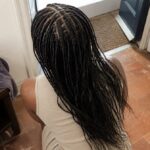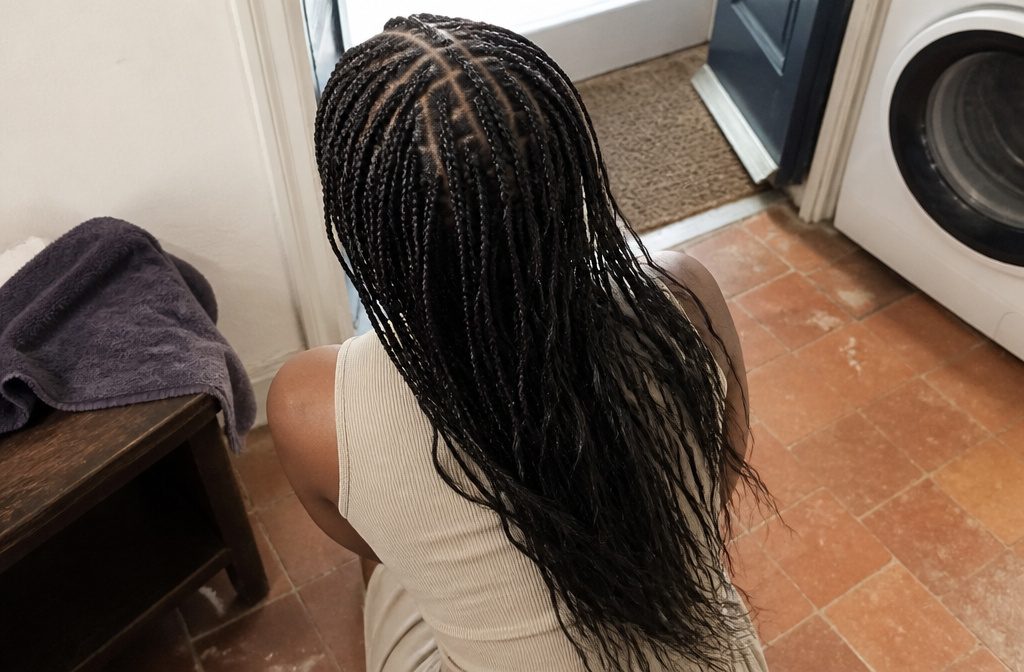
Pick and drop braids are small braids that start at the scalp and stop 2–8 inches down, with the rest of the extension hair hanging loose.
Because only the root is braided, the style is lighter and pulls less than full box braids. The loose ends tangle and dry out faster, so they need daily detangling.
What Pick-and-Drop Braids Are and How They Work
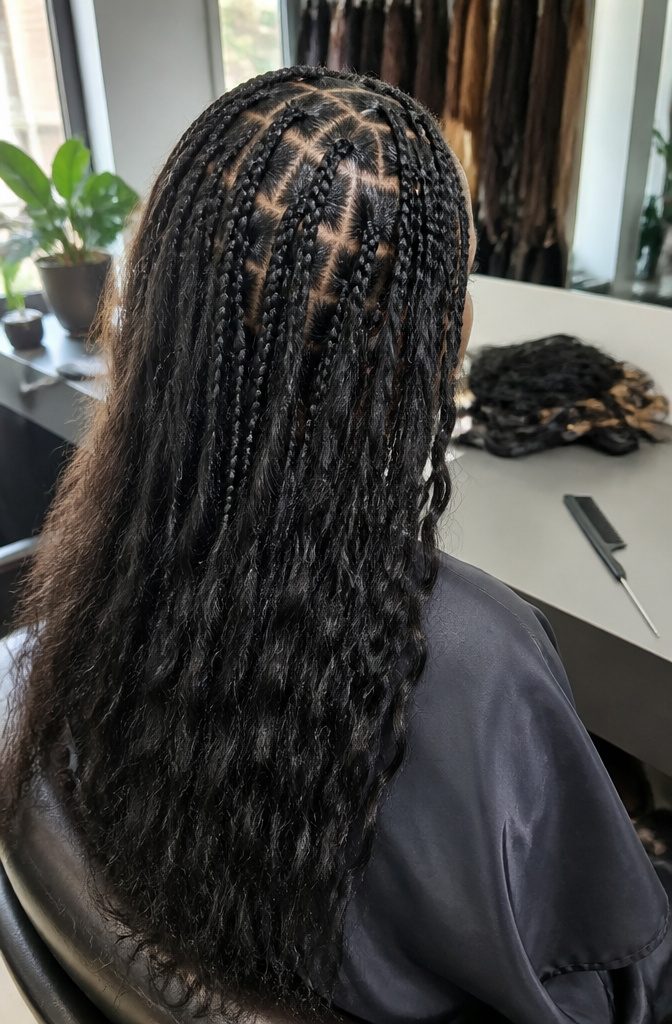
Pick and drop braids start at the scalp as small, neat braids and stop 2–8 inches down, leaving the rest of the extension hair loose.
The braided section is commonly about three inches long, though it can extend farther depending on how much coverage you want and how long your natural hair is.
Once the braid stops, the extension hair hangs straight, wavy, or curly, creating movement that mimics naturally growing hair rather than the uniform structure of box braids braided all the way to the ends.
The parts can be square, rectangular, diamond, or brick-layered.
Each section gets a braided root, then bulk extension hair left loose from the stopping point down. The braid is secured at the transition so it doesn’t unravel, and the loose hair covers most of the braided sections.
The result looks softer and loftier than fully braided styles, with a finish that reads as natural hair flowing from the scalp rather than installed extensions.
Why I Choose This Style Over Fully Braided Box Braids
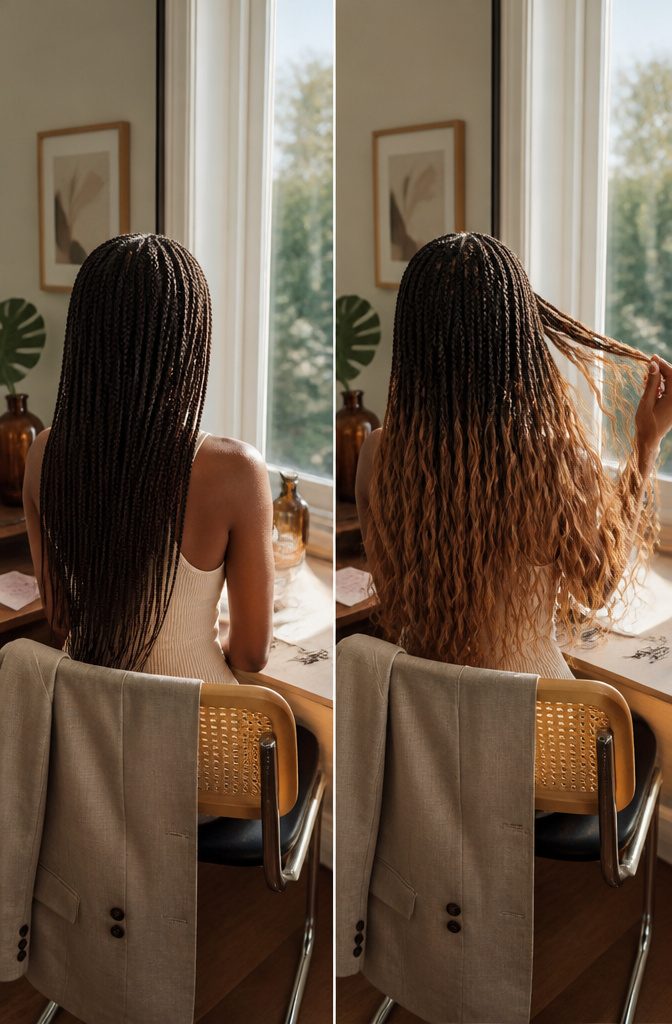
Pick and drop braids are lighter than fully braided box braids because only a few inches at the root are braided, and the rest hangs loose.
The difference is immediately noticeable. Full box braids mean the entire length is wrapped in synthetic or human hair, which adds weight from scalp to ends.
Pick and drop starts the braid at the crown, usually around three inches down, then lets the extensions flow free in waves or straight sections.
The result is a style that moves more naturally and puts far less tension on the roots.
That reduced tension matters for anyone who has dealt with tightness at the hairline or soreness after a full install.
The braided portion is smaller, so the pull is distributed differently. You still get the protective benefit at the root where your natural hair is tucked away, but without the constant weight tugging downward all day.
The loose ends also shift the visual. Pick and drop reads softer and less structured than traditional box braids, which makes it work across more settings.
I can wear it to work, to a wedding, or on a weekend without the style feeling too dressed up or too casual for the occasion.
The texture at the ends can be straight, wavy, or curled depending on the extension you choose, and that range keeps the style from locking you into one look.
How Pick-and-Drop Braids Differ From Boho Braids and Tree Braids
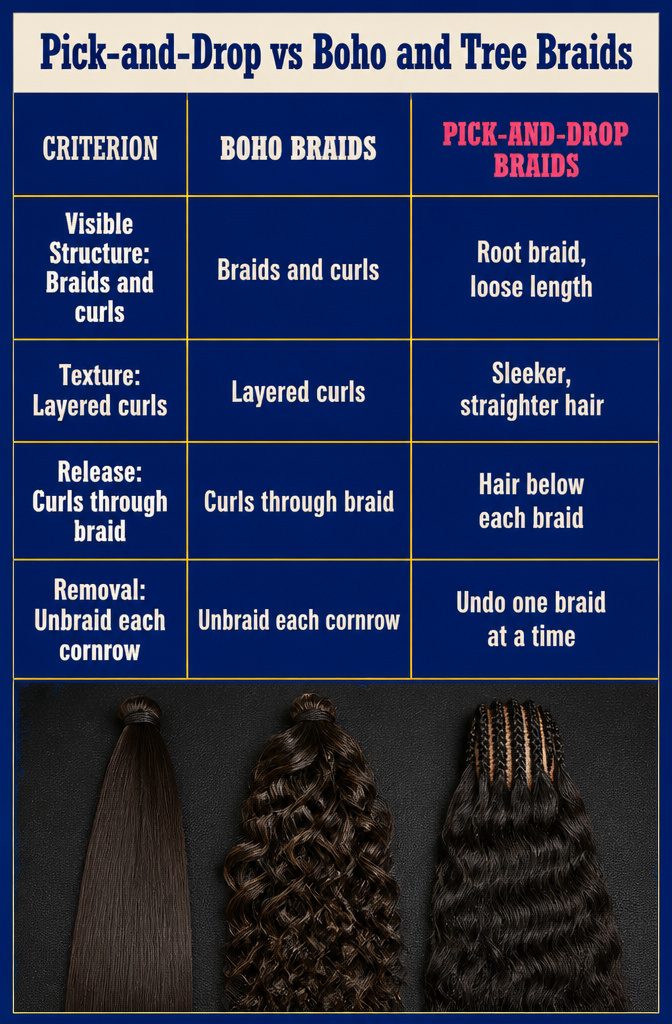
Boho braids keep visible braids with curly strands distributed through them, while pick-and-drop lets loose hair dominate the length. In boho braids, you see both the braid structure and textured curls running down most of the style.
Pick-and-drop concentrates the braid at the root, then releases the extension below it so the finished look resembles loose hair rather than a braid-and-curl combination. Boho leans toward textured, layered curl; pick-and-drop leans sleeker and straighter.
Tree braids release hair repeatedly along individual cornrows, which means the loose pieces sit inside a row and the movement follows the cornrow direction.
Pick-and-drop releases hair below each individual braid, so every section can move independently and the individual parts stay hidden underneath.
At removal, tree braids require you to follow and unbraid each cornrow; pick-and-drop sections come apart one braid at a time.
Crochet braids loop through cornrows using a crochet hook rather than attaching extension to individual sections.
The method differs more than the finished look, though crochet typically works faster because you are not hand-braiding each piece from scalp to release point.
Choosing Between Human Hair and Synthetic Extensions
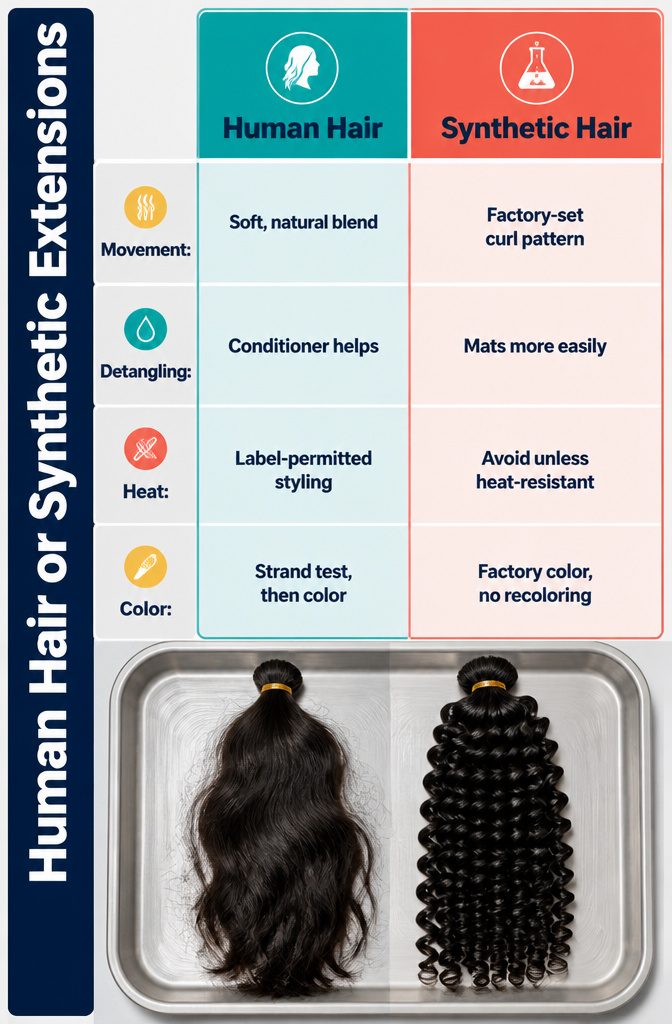
Both materials work, but I give human hair the edge for pick and drop braids.
It blends into your own hair, moves softly, detangles with a good conditioner, takes heat when the label allows it, and can be colored after a strand test.
Synthetic costs less, though its curl pattern is set at the factory, heat is off limits unless the pack says heat-resistant, and the shine can look brighter than real hair.
Format matters as much as material.
Loose bulk hair is the one to buy, because your stylist needs to pull small amounts for every root. Weft bundles can shed and waste hair once pulled off the track.
Pre-looped crochet hair attaches fast but won’t give true individual roots. Feather crochet hair suits a flatter, natural-blend look.
Picking a Texture for the Loose Ends
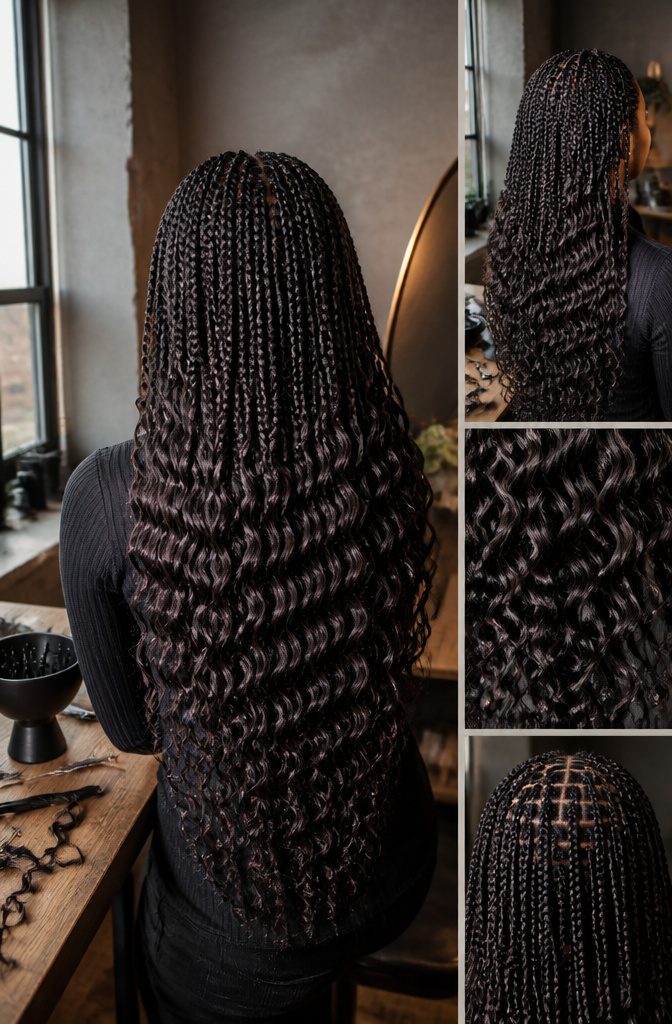
The texture you pick decides whether the finished style reads sleek, soft, or full.
Straight and kinky straight lean modern and controlled; waves and curls add movement and dimension. Match the texture to how you want the loose ends to sit.
- Straight – Sleek, silk-pressed finish
- Kinky Straight – Mimics stretched Type 3 or Type 4 hair; reads like a salon blowout
- Body Wave – Relaxed movement without pronounced curl
- Loose Wave – Soft, natural waves
- Wet and Wavy – Flexible texture that tightens when wet
- Water Wave – Soft curly definition
- Loose Deep Wave – Full, dimensional curls; stronger definition than Water Wave but less compact than Deep Wave
- Deep Wave – Tight, photo-ready curl pattern
Straight wins when you want a polished, minimal look.
Kinky straight bridges the gap if your natural hair is textured and you want the extension to blend without looking processed. Loose deep wave and deep wave give you volume and shape for side-swept styles or layered shoulder-length cuts.
Planning the Install: Length, Density, Color, and Stopping Point
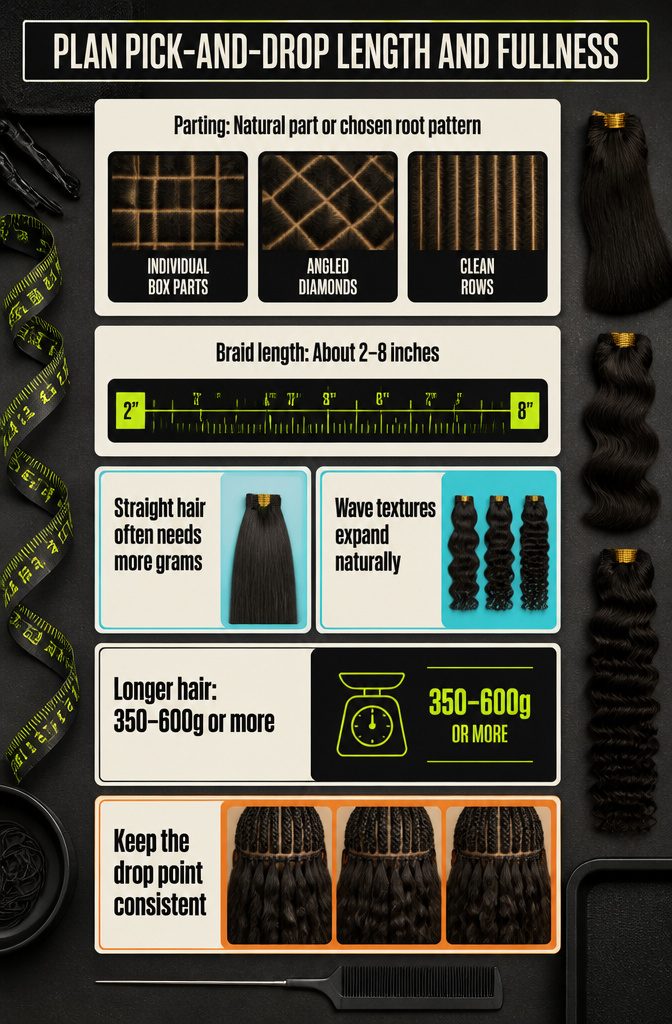
The shape, stopping point, and volume you plan before the install decide how the style sits and how long it takes to finish.
Part shape follows your natural parting or the pattern you want visible at the root—individual box parts, angled diamonds, or clean rows that feed into cornrows at the front if you’re mixing structures.
Braid length runs from roughly 2 inches, which creates very short hidden roots and drops the loose hair almost immediately, up to 8 inches for more visible braided structure and better hold at the attachment.
Texture follows in a separate decision, but straight and double-drawn hair often needs more total grams to fill the same visual space than Water Wave or Deep Wave, which expand naturally.
Total length matters for weight and quantity. Fourteen to twenty inches stays lightweight and moves easily, twenty-six inches and longer pulls 350 to 600 grams or more depending on how full you want the finished look.
Common human-hair installs run 250 to 500 grams total. Density stacks on top of length: fine natural hair or a sleeker finish pulls from the lower end, thick natural hair or very full coverage pushes toward the top.
Color can match your natural shade exactly, sit one or two levels lighter for dimension, or jump to ombré if you’re dropping into ends that read as a separate piece.
The stopping point is where each braid transitions into loose extension, and keeping that zone consistent across the whole head gives you one clean visual line when the hair moves.
How Much Hair to Buy by Length and Density
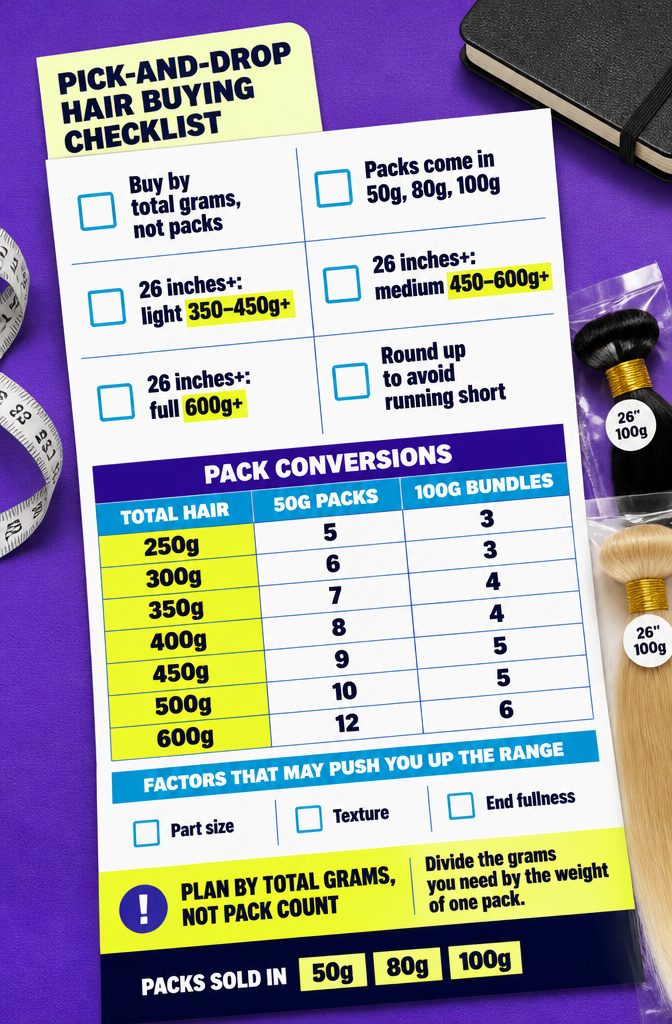
Plan by total grams, not pack count, because hair is sold in 50g, 80g, and 100g weights.
Divide the grams you need by the weight of one pack. At 26 inches and longer, budget 350–450g+ for light density, 450–600g+ for medium, and 600g+ for full.
Conversions for 50g packs and 100g bundles:
| Total hair | 50g packs | 100g bundles |
|---|---|---|
| 250g | 5 | 3 |
| 300g | 6 | 3 |
| 350g | 7 | 4 |
| 400g | 8 | 4 |
| 450g | 9 | 5 |
| 500g | 10 | 5 |
| 600g | 12 | 6 |
Part size, texture, and end fullness can push you up the range. I round up rather than run short mid-install.
Preparing Your Natural Hair and the Extensions
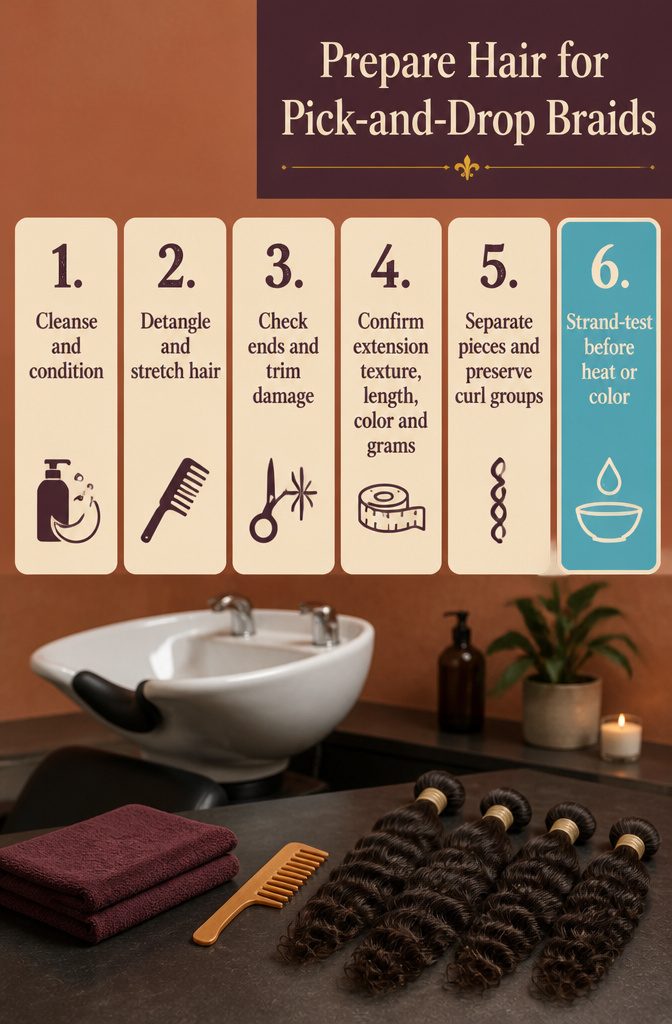
I clean my hair the day before or the morning of the install, deep condition, and detangle completely while the conditioner sits.
Stretched hair cooperates better during parting and braiding, so if shrinkage is tight I’ll blow-dry on low tension or braid damp hair in four large sections overnight and take them down just before the appointment.
I check the ends while detangling and trim anything that looks split or thin, because damaged ends will not blend with the extension hair and the contrast shows once the loose hair is styled.
Human hair extensions arrive in bundles, and I confirm texture, length, color, and total grams before I start separating anything.
I pull the hair into braid-sized pieces, keeping strand direction consistent and making smaller pieces for the hairline where braids sit closer together.
Wavy and curly textures stay in their original curl groups instead of being combed apart, which keeps the pattern intact once the hair is installed.
I set aside extra for the crown and any visible part line, organize highlight colors if the look calls for them, and run a strand test before applying any heat or color.
Boiling water and direct flame are off the table for sealing human hair; both can scorch cuticles and ruin the texture you just paid for.
Installing the Braids From Root to Drop Point
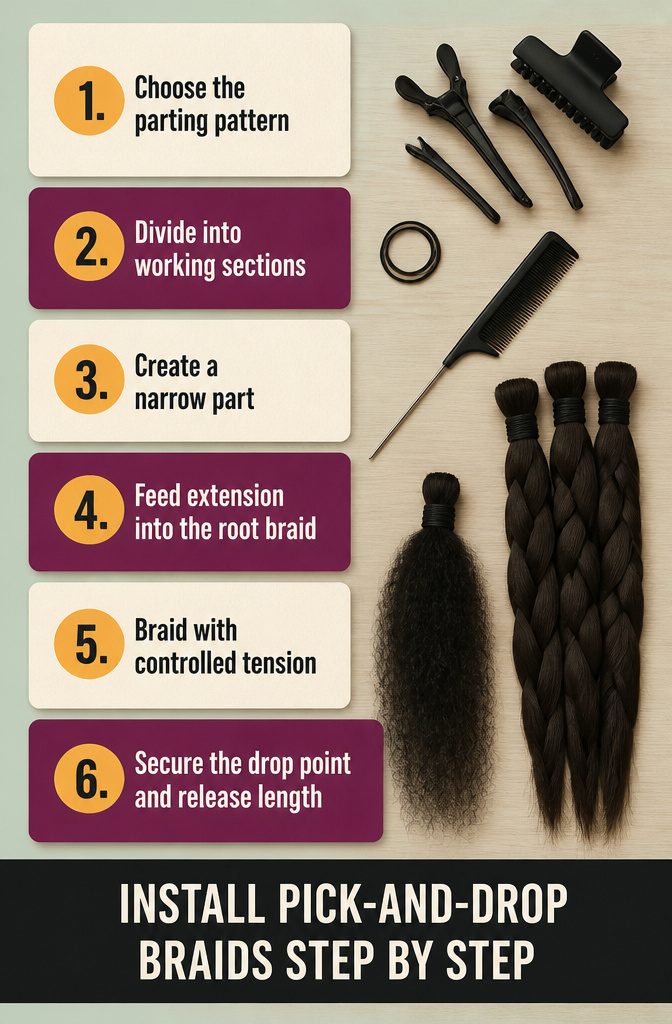
- Choose your parting pattern — horizontal, vertical, or box — before you start, since the first few rows set the grid for everything that follows.
- Divide the head into working sections using large clips. Most installs work one quadrant at a time.
- Create the first part within your working section, no wider than half an inch, and clip the rest away.
- Add the extension hair at the root using a knotless method: start the braid with your natural hair alone for two or three stitches, then feed the extension in gradually to avoid tension knots at the base.
- Braid down with controlled, even tension — tight enough to hold but loose enough that your scalp does not pull.
- Select your drop point, usually mid-length or lower depending on how much loose hair you want showing.
- Secure the braid at that point with a small elastic or by knotting the extension hair around the last stitch.
- Release the remaining natural hair and any loose extension length below the stop point.
- Repeat the process part by part until the whole head is done.
- Shape the style by trimming or curling the loose ends once all braids are in. A professional install typically takes five to ten hours.
Securing the Transition Without Bulky Knots
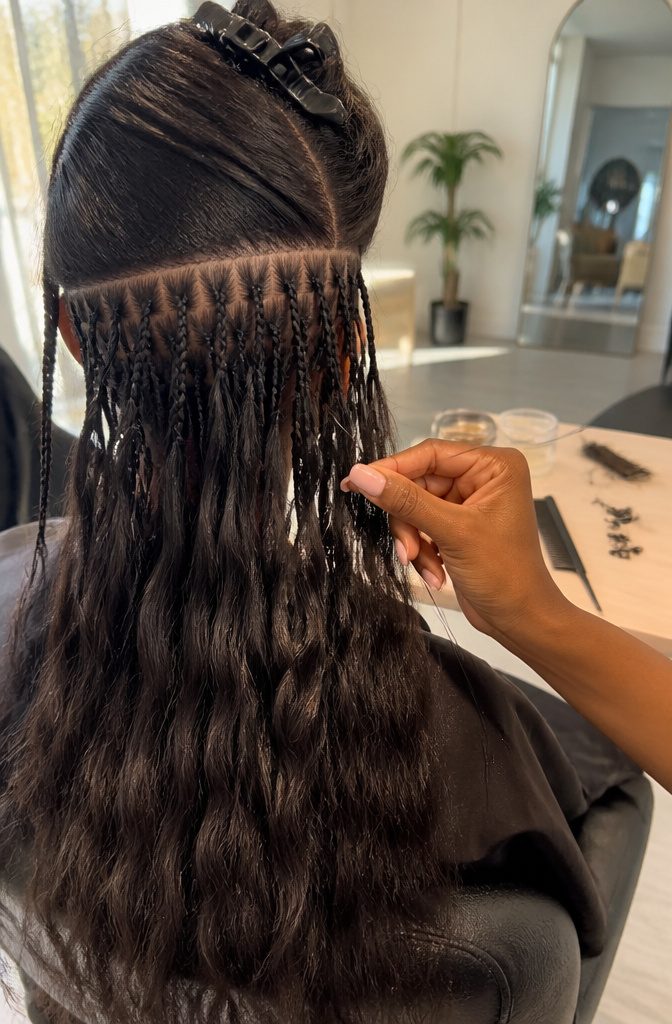
A very small elastic tucked below the final braid stitch suits smooth, straight textures, as long as it never compresses your natural hair.
Fine thread wrapped at the stopping point works for small braids and reusable human hair. For body wave or textured hair, I prefer a thin extension strand wrapped around the last stitches with steady tension so it doesn’t slide.
A reinforced knot suits grippy textures, but keep any knot small and flat, since a big one shows and tangles.
Stagger the stopping points rather than ending in one line, and keep the top layer slightly longer. Extra loose hair around the crown covers the rest.
Maintaining the Style and Caring for Loose Ends
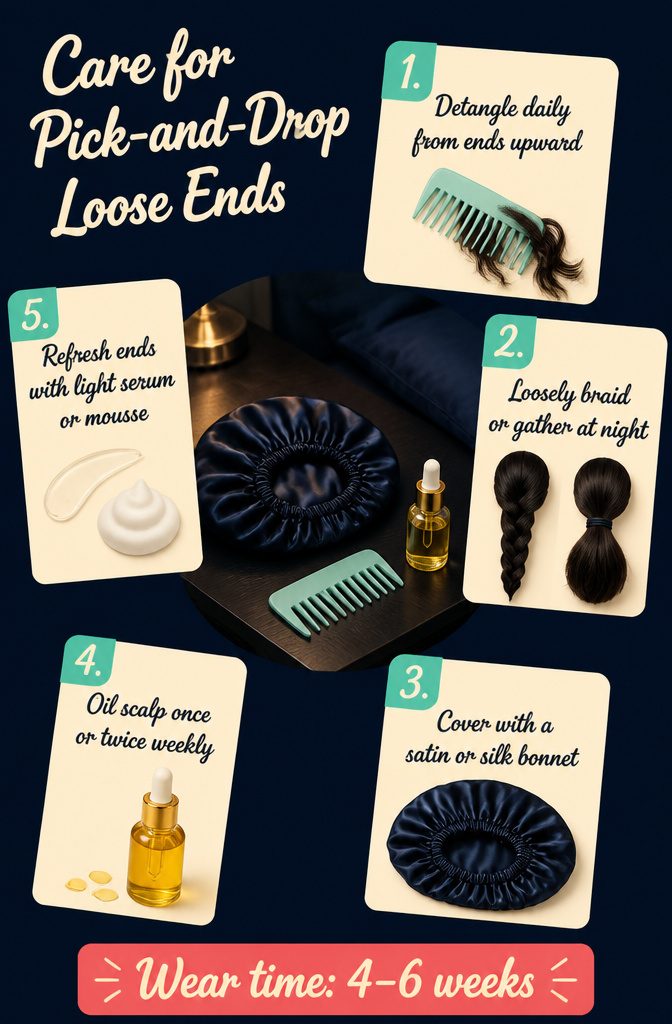
Loose ends tangle, frizz and dry out faster than braided hair, and synthetic extensions mat more easily. Detangle the drop daily, working from the ends up with your fingers or a wide-tooth comb.
At night, split the loose hair into sections and braid them loosely, or gather it in a loose ponytail at the front of the crown, then add a satin or silk bonnet.
Lightweight oil on the scalp once or twice a week prevents dryness and flakes; massage it in rather than scratching.
A bit of serum or mousse on the ends refreshes waves and curls, but I’d skip heavy products, which attract dust and build up.
Expect 4–6 weeks, depending on hair growth, upkeep and extension type.
Styling the Finished Braids Up, Down, or Half-Up
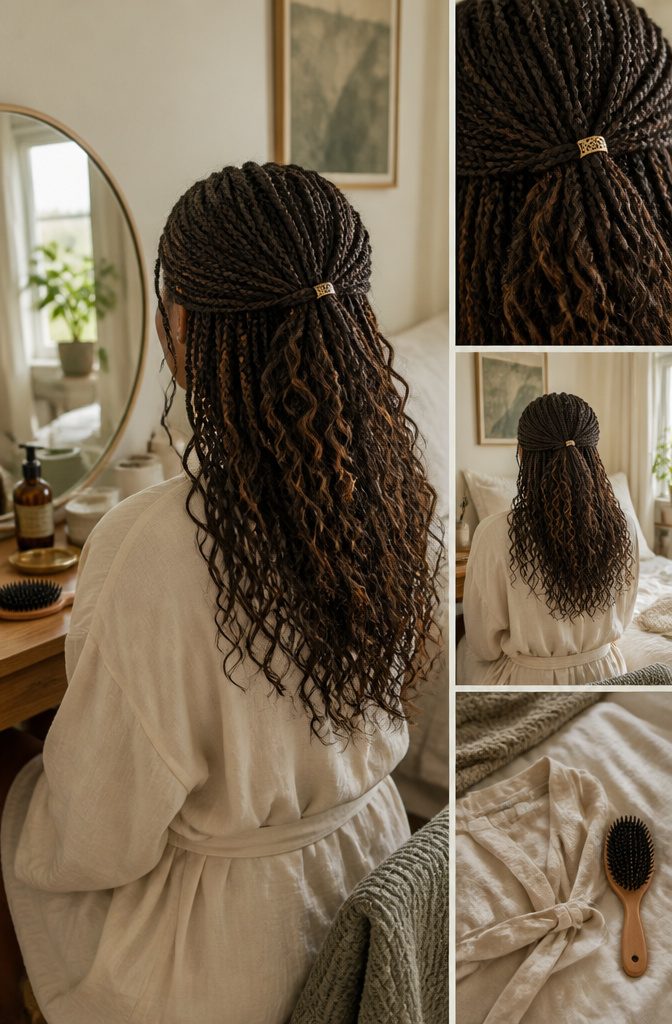
Loose ends give pick and drop braids movement that fully braided styles can’t match, since the unbraided hair swings and curls however you wear it.
- Down: the easiest option, and the best way to show off the flowing ends. If they’re curly or wavy, a little mousse or curl foam keeps them defined.
- High ponytail: a lifted, youthful look, with the ends fanning out from the top.
- Half-up, half-down: softer and more elegant. I’d choose this when you want polish without losing length.
- Low bun: the sleekest version of the style.
- High bun: pull the braids up and let the curly ends fall at the sides. A middle part makes it look deliberate.
- Scarves, beads or gold cuffs: they add detail without overwhelming the braids. I’d stick to one kind at a time.
Variations: Short, Long, Curly, Ombré, and Cornrow-Front Styles
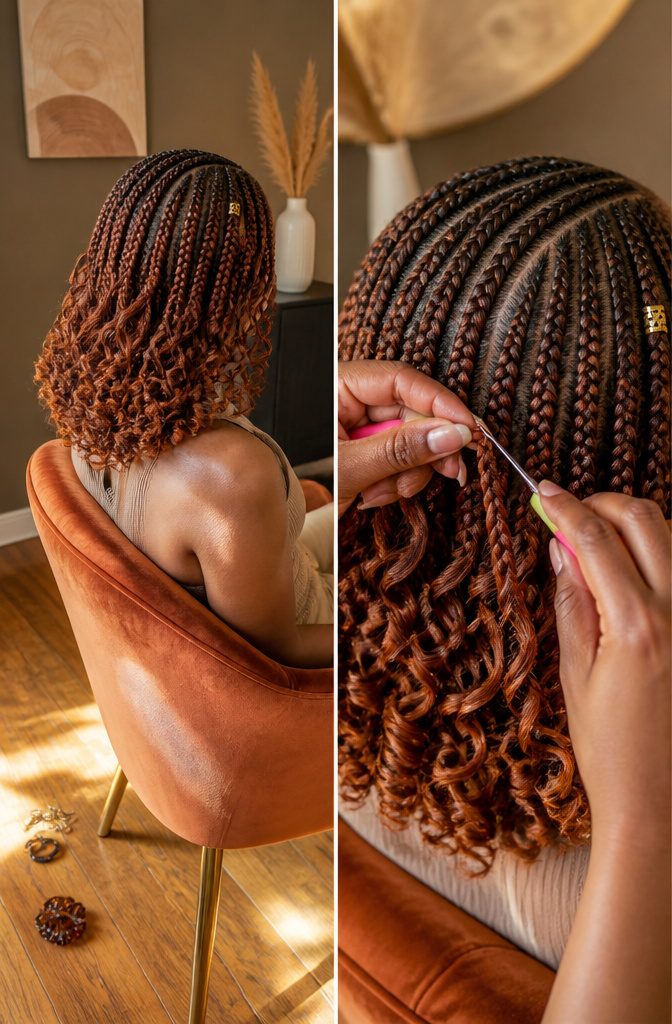
Black is the classic, and it works for any occasion. Blonde adds a soft, sun-kissed glow that suits any skin tone.
Copper is rich and warm, bold yet elegant, while ginger is bright and fiery. Multicolored mixes are the adventurous pick.
For a statement on a short cut, I’d choose auburn with voluminous curly ends.
It reads sophisticated and bold at once. A middle-part high bun with curly blonde strands falling at the sides is better when you want the loose ends visible without the flow.
Half up, half down is the elegant option, and a high ponytail looks lifted and youthful. Beads or gold cuffs add detail without crowding the braids.
The 1990s and Early 2000s Origins of the Style
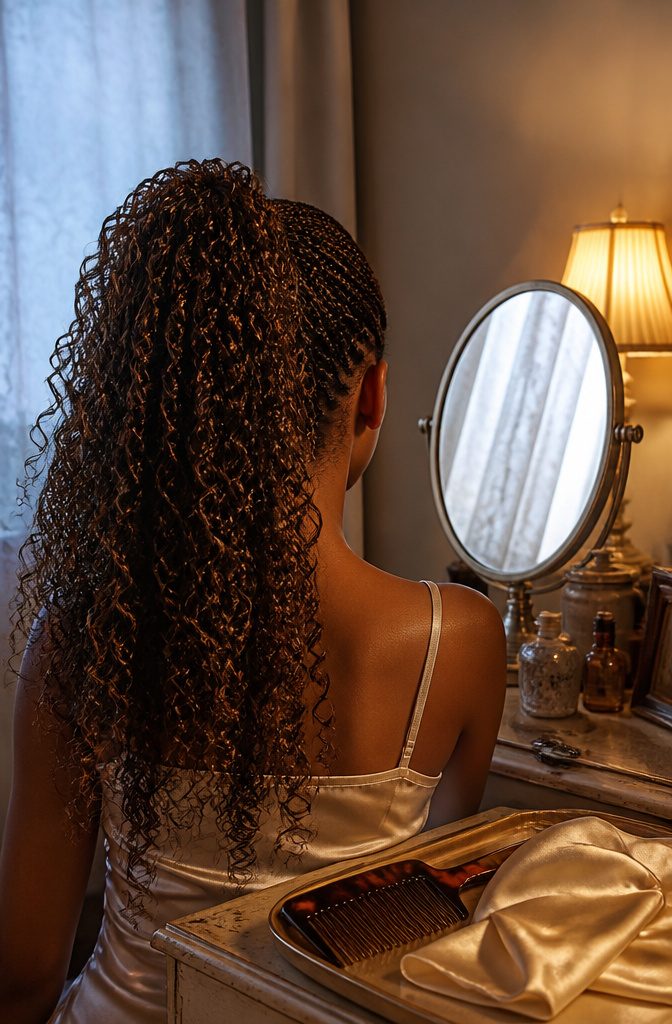
Pick and drop braids were everywhere in the late 1990s and early 2000s. The image most people have saved is Beyoncé’s ponytail version at the 2003 NBA All-Star Game.
Brandy, Kelly Rowland, and Solange all wore the style in that same era, so a photo of any of them makes a solid reference for a stylist.
Boho braids, goddess braids, and French curls grew out of this older look.
Those newer versions get more attention now, but the original has held its place. It is protective, low tension, and natural looking, and I’d start with the ponytail version if you want to copy the classic exactly.
Frequently Asked Questions
What are pick and drop braids?
Pick and drop braids are box braids that start at the scalp and stop 2–8 inches down, commonly around 3 inches, with the rest of the extension hair left loose.
The loose length can be straight, wavy, or curly. It covers the braided roots, so the hair looks like it grows naturally from your scalp.
What is the difference between boho braids and pick and drop braids?
In pick and drop braids, the braiding stays near the root and the loose hair makes up most of the length.
Boho braids usually stay braided through most or all of the length, with curly or wavy strands mixed in. Pick and drop finishes sleeker and straighter, while boho looks more textured and layered.
What hair is best for pick and drop braids?
Human hair is the better choice for most people because it blends with your natural hair, moves softly, and can take heat or color when the label allows.
Synthetic hair costs less, but its curl pattern is fixed at the factory. Buy loose bulk hair rather than wefts or pre-looped crochet hair, since your stylist pulls a small amount for every root.
How do you create pick and drop braids at home?
Start with clean, deep-conditioned, fully detangled hair, then section it and take parts no wider than half an inch.
Begin each braid with your natural hair for 2 or 3 stitches, feed in the extension gradually, and braid with even tension down to your drop point.
Secure it with a small elastic or a wrapped strand, then repeat on every part. A professional install takes 5–10 hours, so plan for a long session.
How do you maintain pick and drop braids?
Detangle the loose ends daily, working from the ends up with your fingers or a wide-tooth comb. At night, loosely braid or gather the loose hair and cover it with a satin or silk bonnet.
Massage a lightweight oil into your scalp once or twice a week, and use a little serum or mousse on the ends instead of heavy products that build up.
How long do pick and drop braids last?
Expect about 4–6 weeks. The exact time depends on how fast your hair grows, how well you maintain the style, and which type of extension hair you chose.
How do you style pick and drop braids?
Wear them down to show off the loose ends, or pull them into a high ponytail, a half-up style, a low bun, or a high bun.
Scarves, beads, or gold cuffs add detail without crowding the braids. If the ends are wavy or curly, a little mousse or curl foam keeps them defined.
Who should get pick and drop braids?
They suit anyone who wants a protective style that is lighter and puts less tension on the roots than fully braided box braids.
They also work for people growing out their natural hair and for anyone who wants volume without weight. The soft finish looks fine at work, at a wedding, or on a weekend.