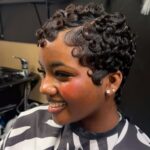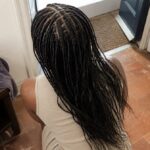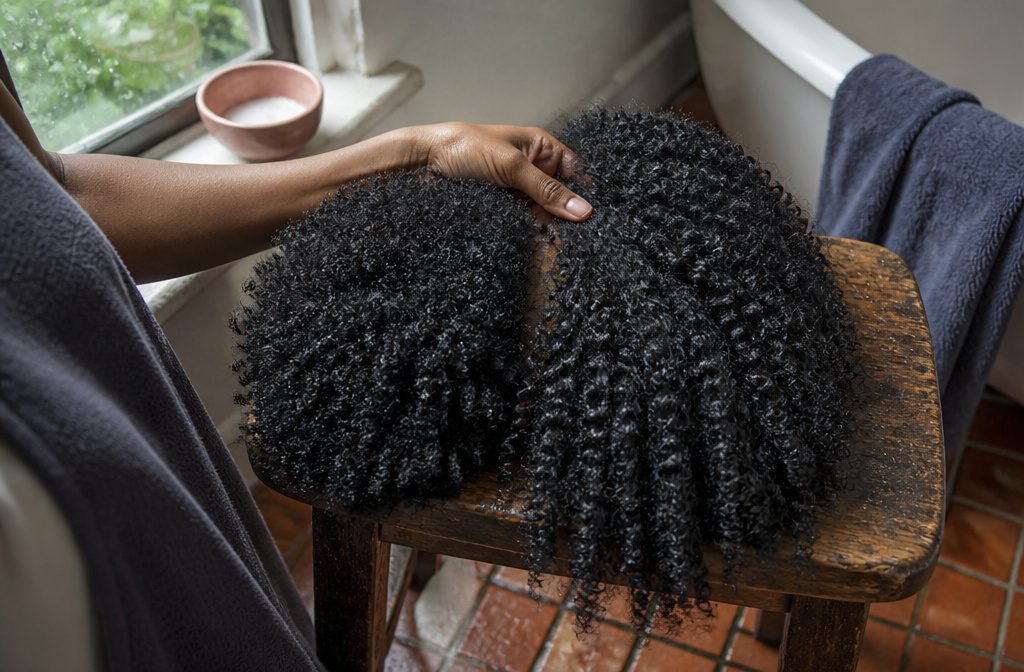
4C hair wins for holding styles longer and showing more volume, but only if you can handle shrinkage that eats 70% of your length and dries out faster than 4B.
4B gives you back about half your length when it dries and holds moisture a little longer, which makes length retention easier to see between trims.
Curl Pattern and Visibility
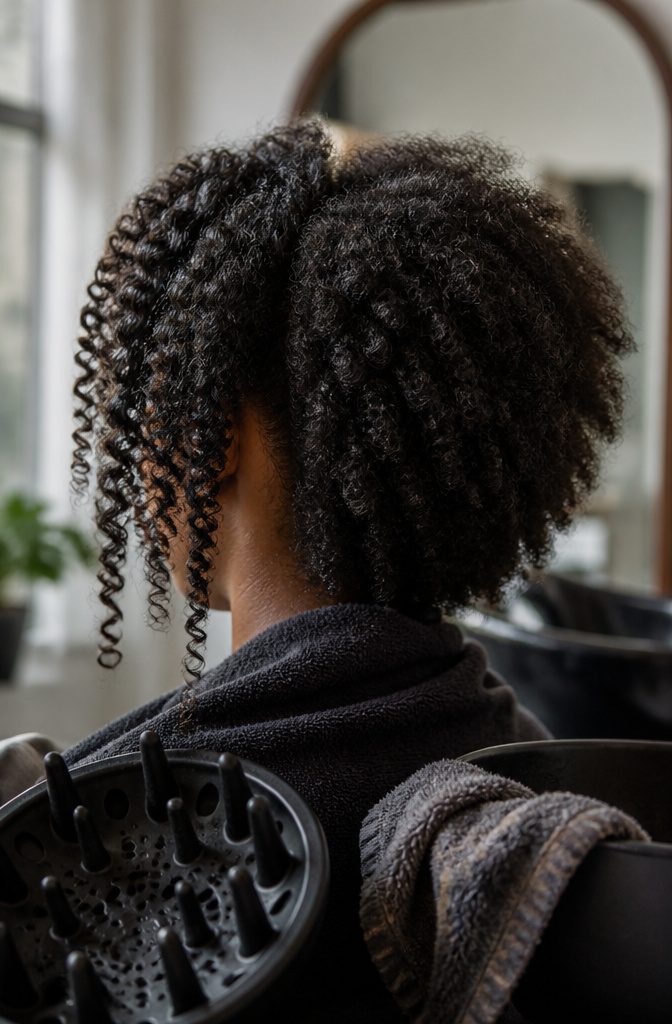
The difference that matters first: 4B hair forms a sharp Z-shaped zigzag, while 4C coils so tightly the curl can be nearly invisible without product or styling.
In 4B, the angles are defined enough that you can trace the pattern with your finger.
In 4C, the coils are so small and densely packed that the hair looks almost cloud-like until you work moisture or gel through it to bring out the tiny corkscrews.
The two can be hard to tell apart at a glance.
Both read as kinky texture from a distance, and both shrink enough that the actual curl structure hides in the volume. Sources differ on how much definition 4B shows on its own.
Some describe it as well-defined zigzags, others as a pattern that needs styling to read clearly. What stays consistent is that 4C is tighter, smaller in diameter, and harder to see without help.
Tightness and Curl Size
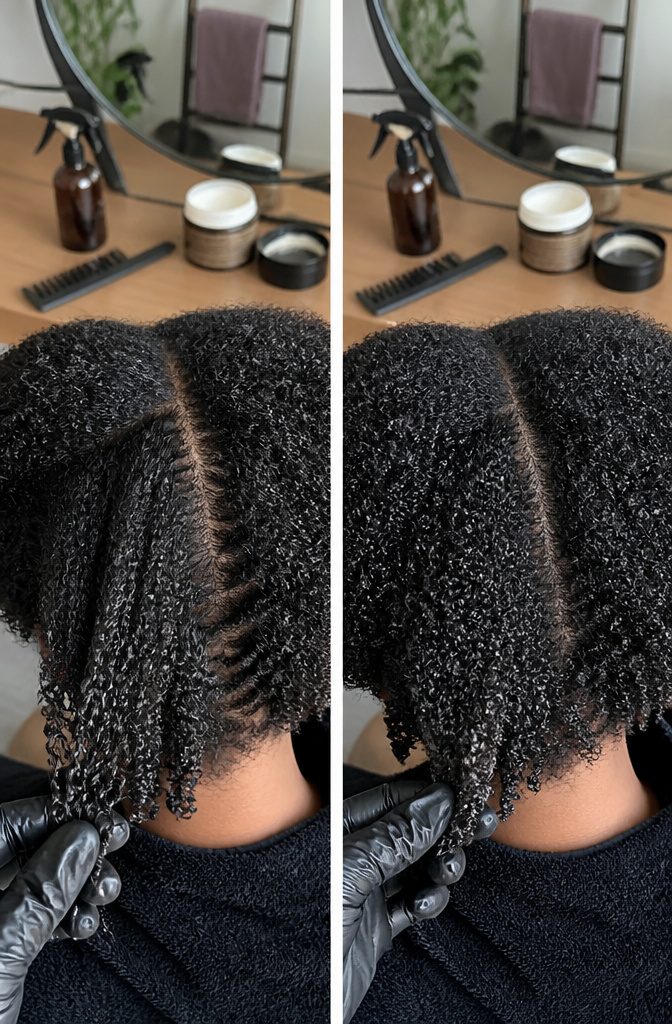
The main visual difference sits in how tightly the strands coil. 4B hair forms a sharper Z-shaped bend that’s less tightly wound than 4C, with wider angles you can see when you separate a section.
4C coils are the tightest pattern in the system, often described as extremely tight corkscrews or zigzags with very small, densely packed coils.
From a distance the two can look similar, but pull a strand and the difference shows: 4B has a visible bend pattern, while 4C spirals so tightly the individual curl shape nearly disappears without stretching or product to define it.
Both textures have thicker strand circumferences than wavy or straight hair, measuring 0.1–0.3 millimeters compared to 0.04 millimeters for looser patterns, according to one analysis.
That density contributes to the volume and the dryness both textures share, but the coil size itself decides how much shrinkage you’ll see and how much moisture the hair holds onto between wash days.
Appearance and Texture
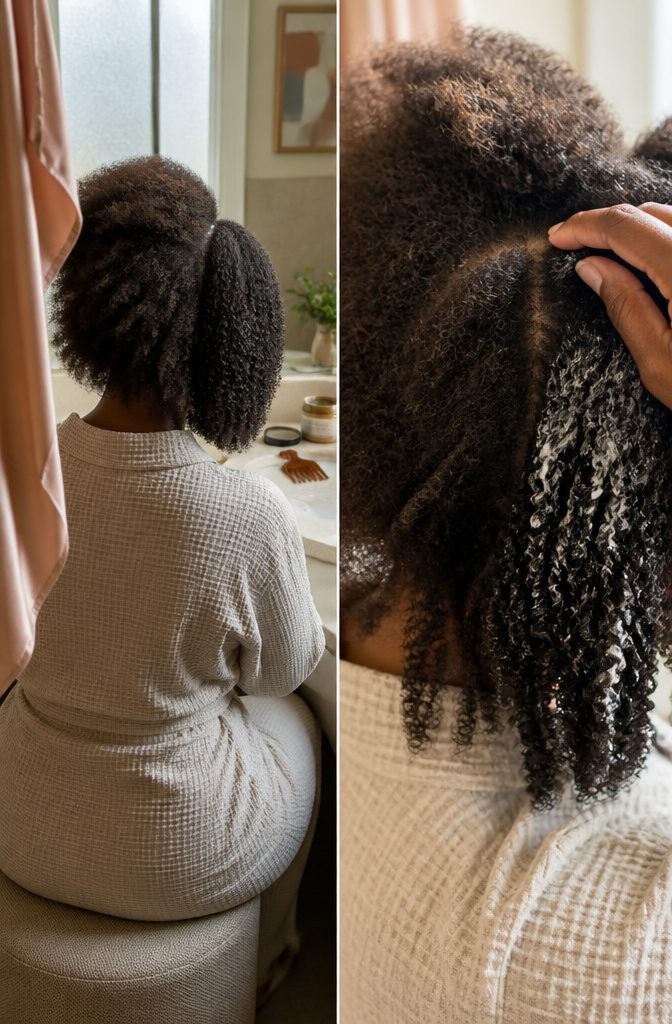
4B hair is fluffy, voluminous and cottony, with Z-shaped coils that are sharply angled and less densely packed. When you style it, the curls can be defined, but left alone the texture reads as soft and kinky.
4C hair looks more compact and fro-like, with coils so tight that the curl pattern only becomes visible once you add product. Without it, the strands pack together and the hair takes on a denser, more uniform silhouette.
I see a lot of people try to tell the two apart from photos, but styling and products completely change how either pattern looks. A well-moisturized 4C fro can read as silky and defined.
A dry 4B wash-and-go can look tight and compressed. The texture under your fingers matters more than the shape you see in someone else’s picture.
Shrinkage
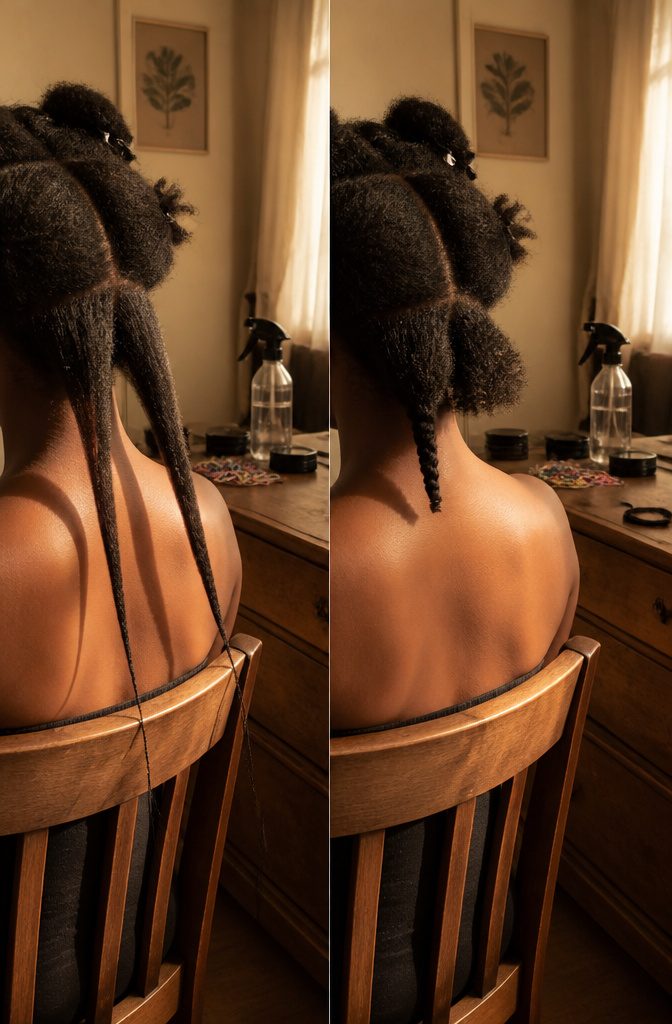
Both hair types shrink dramatically when they dry, but 4C hair shrinks up to 70% of its actual length while 4B typically reaches about 50%.
That means 20-inch 4C hair can look like it measures only 5 inches when completely dry. The difference matters when you pick a protective style or decide whether to stretch before installing twists.
I find the extra shrinkage in 4C makes length retention harder to see, even when growth is steady. Twist-outs, banding overnight, and African threading all help pull the coils longer without heat.
For 4B, shrinkage is still significant but you get a bit more visible length right out of the wash. Either way, stretching techniques keep tangles down and make detangling easier the next time around.
Moisture and Dryness
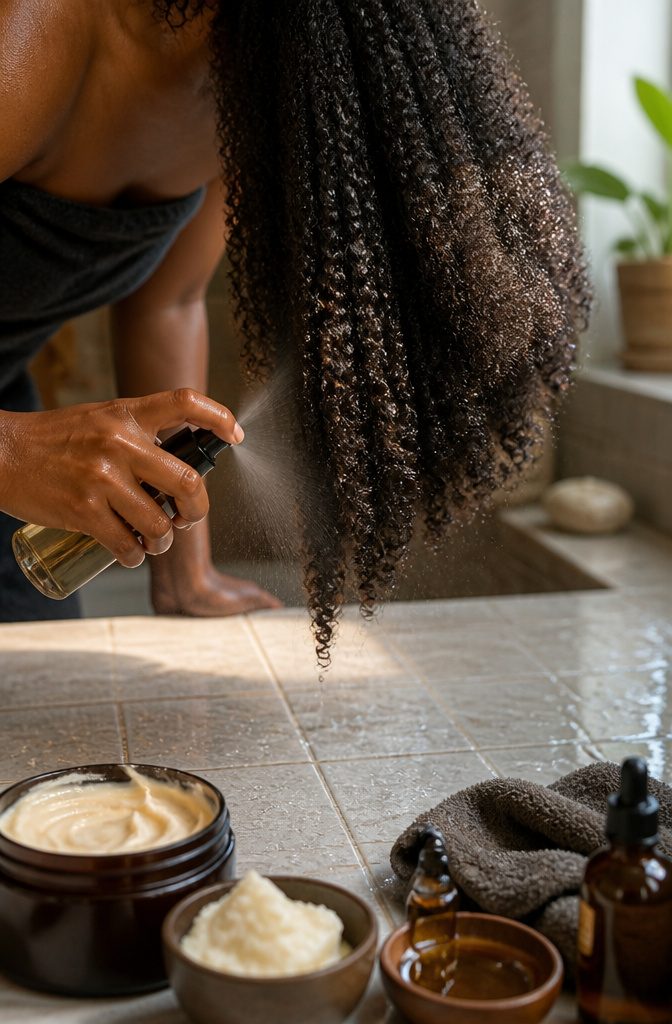
Both 4B and 4C hair need serious moisture, but 4C tends to dry out faster.
The tight coil structure makes it harder for natural scalp oils to travel down the entire strand, so the ends stay thirsty even when your scalp feels fine. That shared challenge just hits harder on 4C.
The tighter the coil, the quicker moisture escapes. 4C’s zig-zag pattern packs so tightly that water doesn’t stick around the way it does on looser textures.
I see this play out in how often you reach for a spray bottle between washes. 4B holds hydration a little longer, but neither texture can coast on a single deep conditioning session and expect softness three days later.
Heavy oils like shea butter, castor oil, and jojoba work better than light lotions for sealing moisture in.
Leave-in conditioners are non-negotiable. Deep conditioning once a week keeps both textures soft and manageable, and co-washing instead of shampooing more than once a week protects the natural oils you do have.
Fragility and Breakage
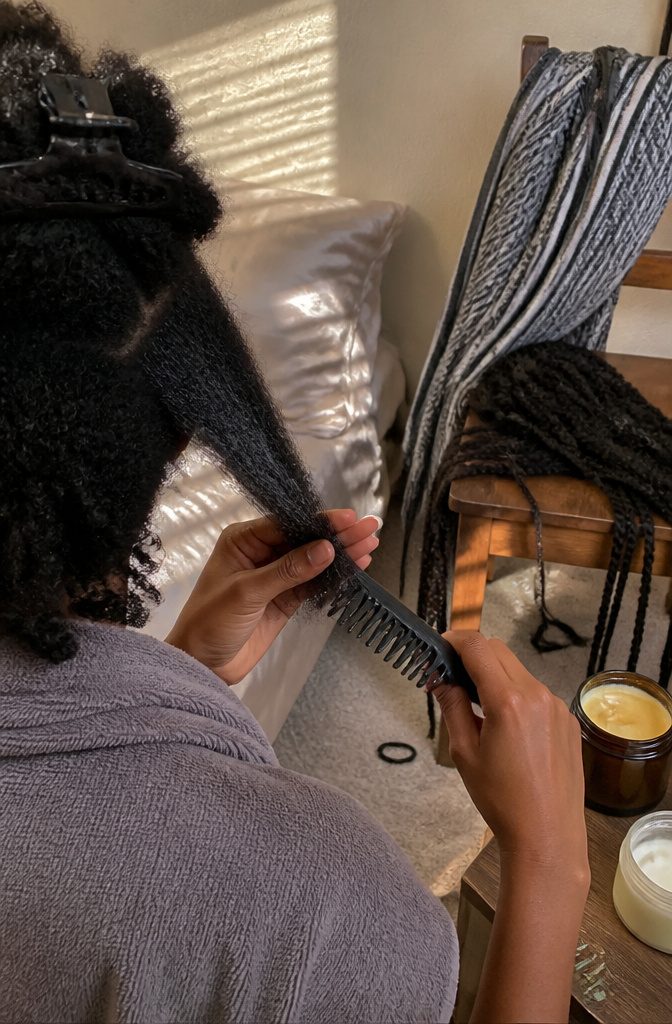
Both types break when they’re dry, tangled, or handled too roughly, but 4C hair breaks more easily than 4B.
The tightly coiled structure in 4C creates more friction and tension along the shaft, which leads to split ends if moisture drops or manipulation runs heavy.
4B hair is fragile too, especially when you skip proper washing, conditioning, or detangling, but the difference sits in degree rather than in kind.
Dryness drives most of the breakage in both patterns. Neither holds moisture as well as looser textures, so regular hydration with heavy oils and butter matters more here than in 3B or 4A hair.
Detangling gently with a wide-tooth comb or just fingers and curl cream cuts down the damage when tangles show up.
Protective styles like braids, twists, and buns reduce daily manipulation and lock in moisture, and 4C hair in particular benefits from styles that keep stress off the shaft while length builds underneath.
Styling and Length Retention
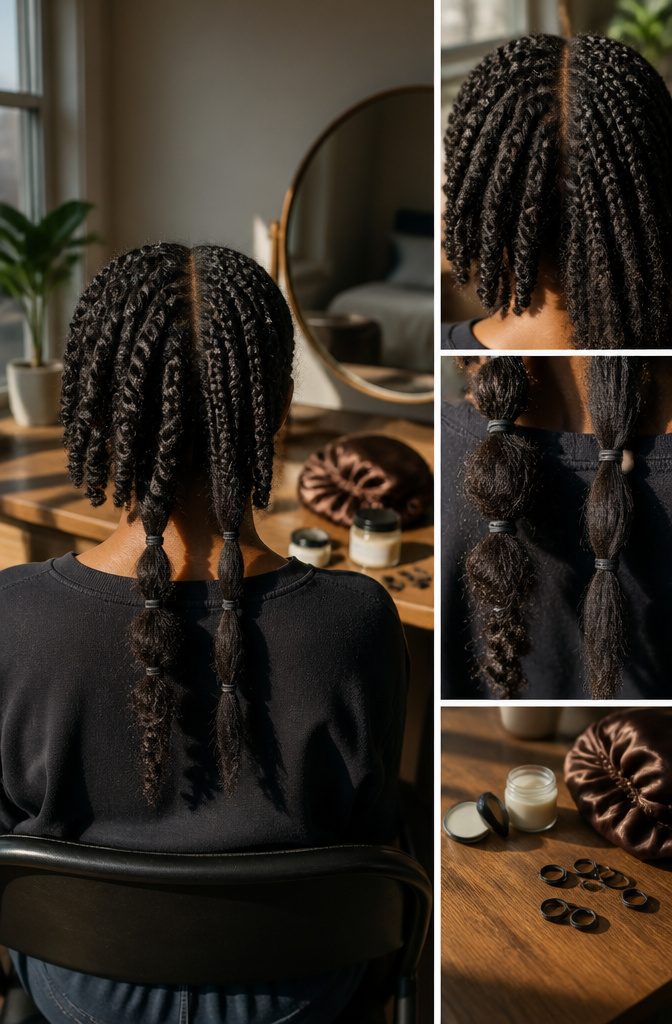
Both hair types respond well to protective and low-manipulation styles, though they hold onto them differently.
4B hair typically keeps a style intact for about a week, which gives you breathing room between wash days without the pattern springing back early.
4C holds styles even longer than 4B, a bonus when you want a twist-out or braid-out to last through several days without touch-ups.
The trade-off comes with shrinkage.
To actually see your length, banding helps: wrap 3–4 rubber bands down each section on damp hair and let it dry. The bands stretch the hair without heat, cutting down on the coil compression that hides how much you’ve grown.
I reach for this before a length check or when shrinkage makes detangling harder than it needs to be. Skip it when you want full volume or when the style depends on the natural coil staying tight.
Care Needs
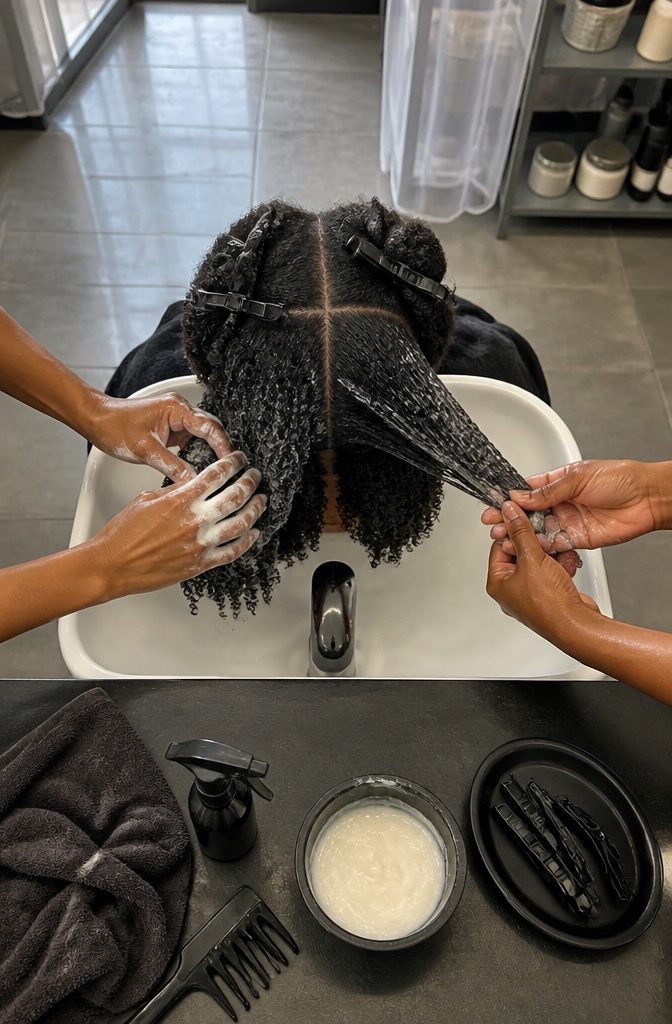
Wash-day frequency splits the two. Shampoo 4B hair once a week with a sulfate-free formula, while 4C can stretch to every two to four weeks or less.
The tighter coil on 4C makes it harder for scalp oil to travel down the strand, so washing less often preserves what moisture is there.
4C benefits from a pre-poo treatment of up to 30 minutes before shampooing. Divide hair into four quadrants, or eight if it’s thick or long, mist with water, and work a moisturizing product from root to tip.
Coconut oil works well for this. The pre-poo adds a protective layer and softens hair before the shampoo strips natural oils.
Deep conditioning advice varies by source.
Some recommend once or twice a week for 4B, others say once a week for 4C. Both textures dry out quickly and need regular moisture replenishment to stay soft and manageable.
| Hair Type | Shampoo Frequency | Pre-Poo | Deep Conditioning |
|---|---|---|---|
| 4B | Once a week | Not specified | Once or twice a week |
| 4C | Every 2–4 weeks or less | Up to 30 minutes (coconut oil or moisturizing product) | Once a week |
Shrinkage Numbers by Source
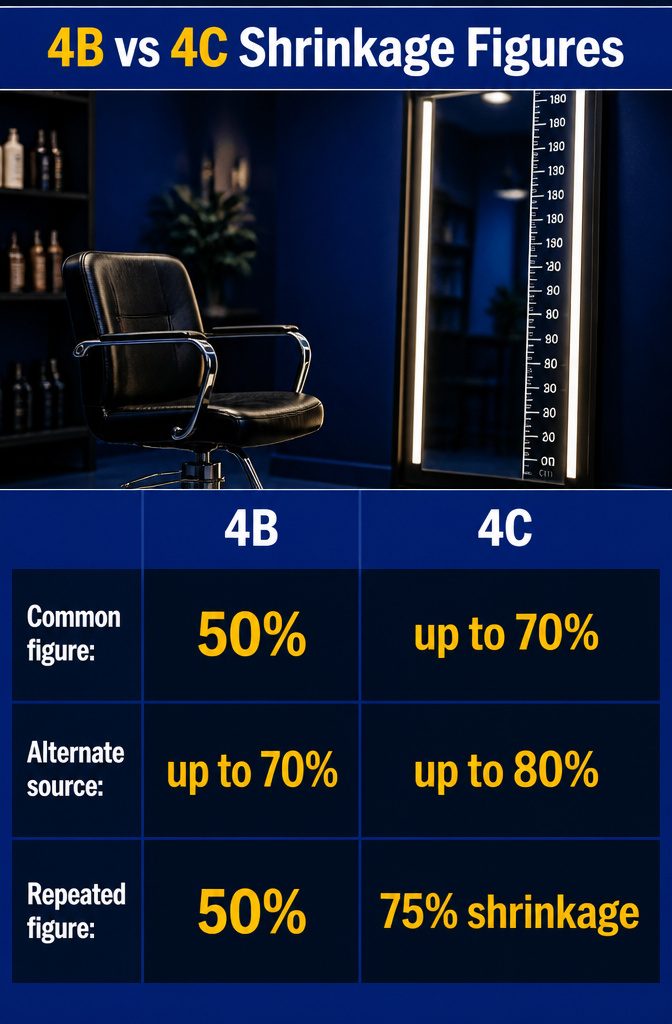
The numbers shift depending on where you look. I pulled figures from four different sources, and none of them line up neatly.
| Hair Type | Shrinkage Range | Source Context |
|---|---|---|
| 4B | 50% of true length | Most common figure cited |
| 4C | Up to 70% of true length | Same source as 50% for 4B |
| 4B | Up to 70% | Alternate source |
| 4C | Up to 80% | Same alternate source |
| Type 4 (both) | Up to 75% shorter | General Type 4 figure |
| 4B | 50% shrinkage | Repeated figure |
| 4C | 25% of true length (75% shrinkage) | Same source as repeated 4B |
One puts 4C at 70% shrinkage, another at 75%, and a third at 80%.
The 4B range is narrower but still moves between 50% and 70%. What matters for styling is that both types shrink dramatically, and 4C consistently shows more shrinkage than 4B, no matter which set of numbers you follow.
Detangling and Nighttime Care
Detangling and Nighttime Care
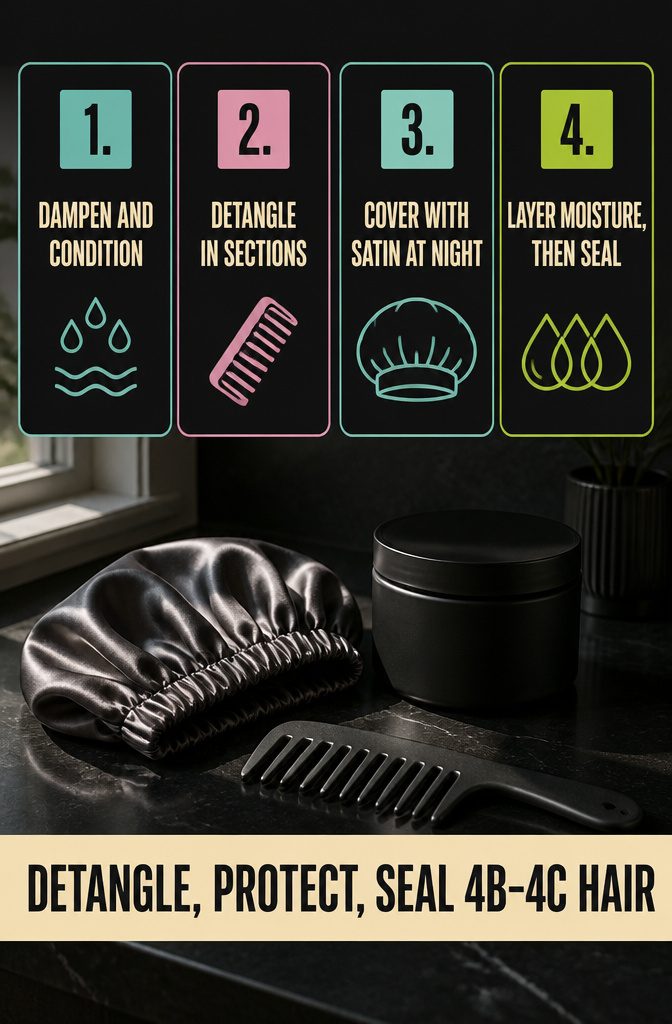
Detangle when your hair is damp and coated in conditioner, working in sections with your fingers or a wide-tooth comb.
Both textures respond better to wet detangling than dry, and sectioning keeps you from fighting the whole head at once. 4C hair especially benefits from the section-by-section approach since shrinkage makes knots harder to see.
At night, wrap your hair in a satin bonnet or scarf to hold moisture and protect whatever style you set. The satin keeps hydration from wicking into cotton pillowcases and flattens fewer coils than sleeping loose.
For layering moisture, you’ll see two methods recommended: LCO (liquid, cream, oil) or LOC (liquid, oil, cream). The liquid is usually water or a water-based leave-in, the cream adds weight and slip, and the oil seals.
Which order works better depends on how your hair drinks product, but both start with damp hair and end with a seal.
Frequently Asked Questions
What is 4B hair?
4B hair is a tightly coiled texture with sharp Z-shaped bends that create a fluffy, voluminous appearance.
The curl pattern is visible but less defined than looser textures, and the hair shrinks about 50% of its actual length when dry. It’s delicate, dries out quickly, and needs regular moisture to stay soft and manageable.
What does 4C hair look like?
4C hair has extremely tight coils so small the curl pattern is nearly invisible until you add product or moisture.
Without styling, it looks dense and fro-like rather than defined. The coils are packed so closely together that the hair can shrink up to 70% of its true length, hiding how much you’ve actually grown.
How often should I wash 4B or 4C hair?
Wash 4B hair once a week with a sulfate-free shampoo, while 4C can go 2 to 4 weeks or longer between washes.
The tighter coil in 4C makes it harder for scalp oil to travel down the strand, so washing less often helps preserve moisture. Both textures benefit from deep conditioning once a week.
Is 4C hair fragile?
Yes, 4C hair breaks more easily than other textures because the tight coil structure creates more friction and tension along the shaft.
Dryness drives most of the breakage, so regular hydration with heavy oils and gentle detangling with fingers or a wide-tooth comb are non-negotiable. Protective styles help reduce daily manipulation and lock in moisture while length builds.