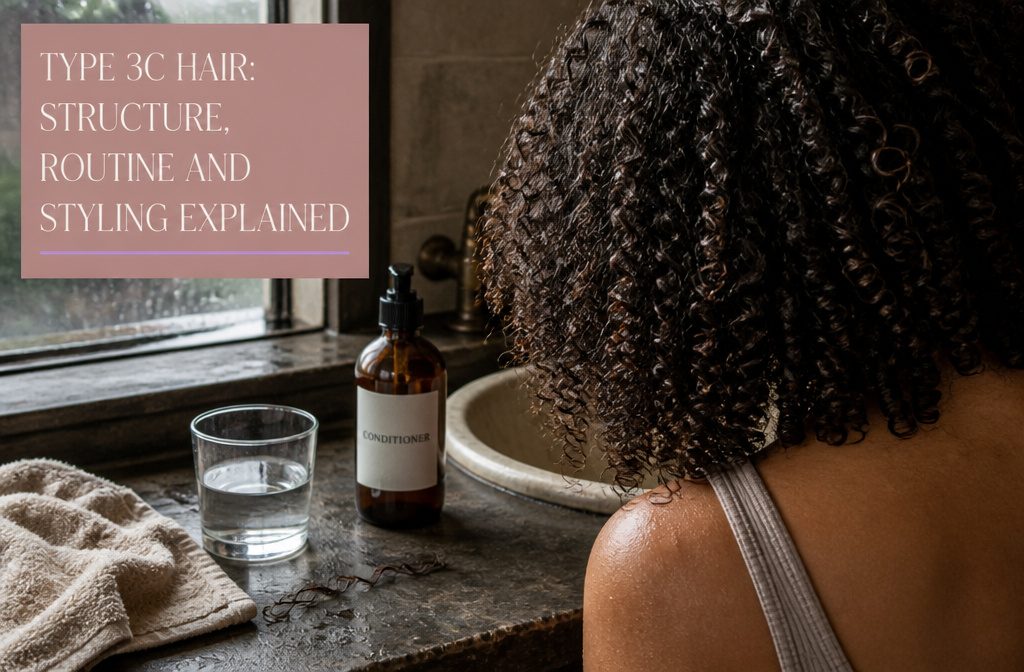
Type 3C hair is the tightest of the type 3 curls: springy corkscrew ringlets about the width of a pencil (6–8 mm), packed close together.
Because scalp oil stalls at every bend, the ends dry out first, and porosity varies from head to head. A water-glass test on a clean strand shows whether yours is low or high.
What Type 3C Hair Looks Like
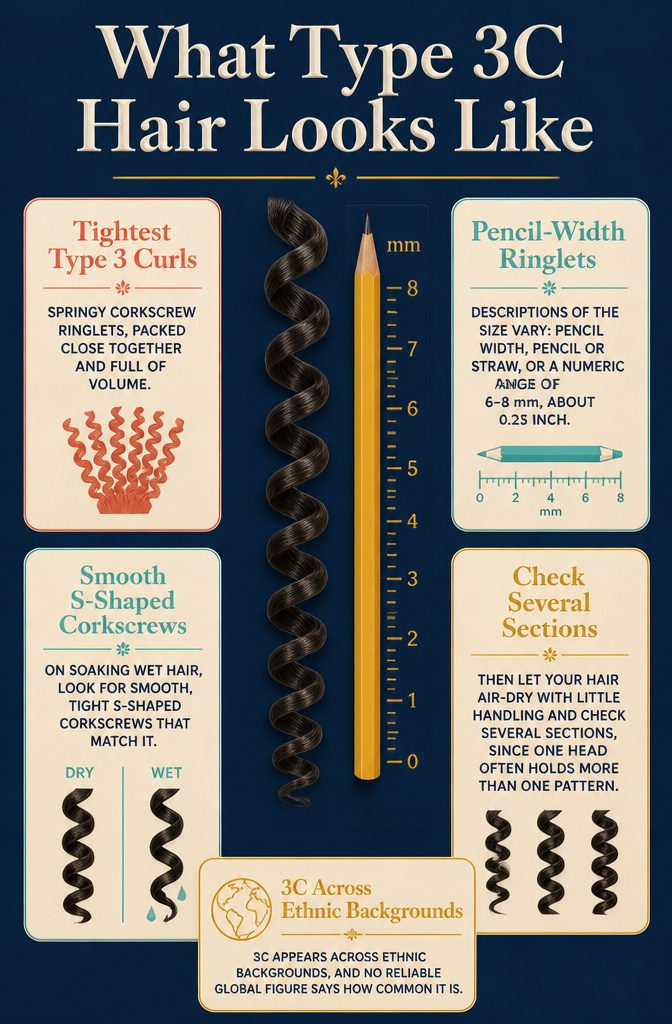
Type 3C is the tightest of the type 3 curls: springy corkscrew ringlets, packed close together and full of volume.
Descriptions of the size vary: pencil width, pencil or straw, or a numeric range of 6–8 mm, about 0.25 inch. I’d go with the pencil.
Hold one beside a dry, product-free ringlet and compare the diameters. On soaking wet hair, look for smooth, tight S-shaped corkscrews that match it.
Then let your hair air-dry with little handling and check several sections, since one head often holds more than one pattern. 3C appears across ethnic backgrounds, and no reliable global figure says how common it is.
3C vs 3B and 4A
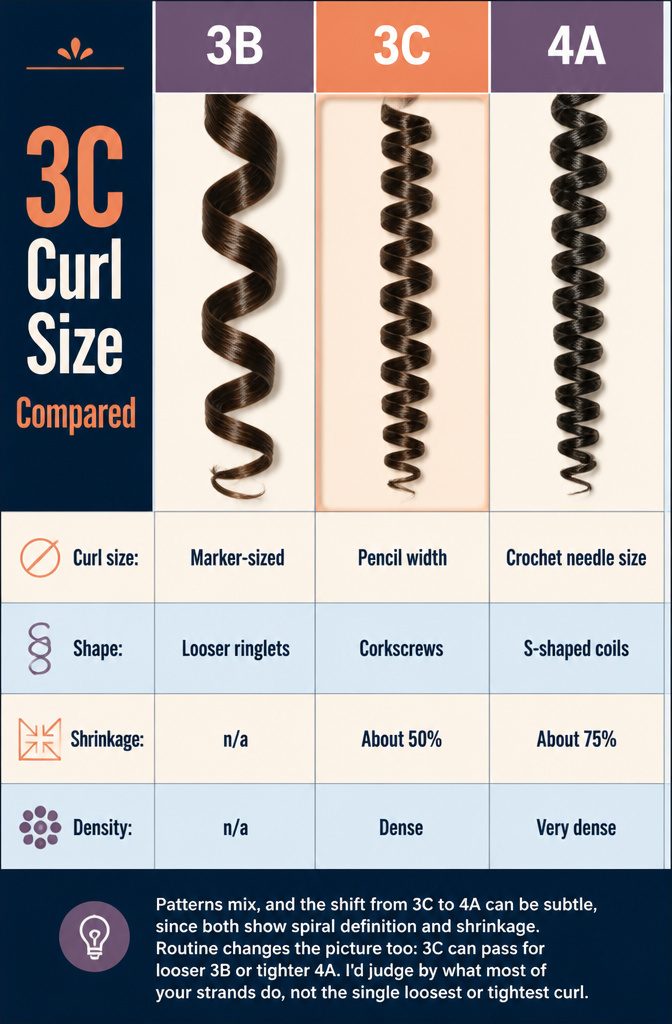
Curl size is the main divider: 3B ringlets run larger and looser, 3C corkscrews are tighter and denser, and 4A coils are tighter again.
| Trait | 3B | 3C | 4A |
|---|---|---|---|
| Curl size | Marker-sized | Pencil width | Crochet needle size |
| Shape | Looser ringlets | Corkscrews | S-shaped coils |
| Shrinkage | n/a | About 50% | About 75% |
| Density | n/a | Dense | Very dense |
Patterns mix, and the shift from 3C to 4A can be subtle, since both show spiral definition and shrinkage.
Routine changes the picture too: 3C can pass for looser 3B or tighter 4A. I’d judge by what most of your strands do, not the single loosest or tightest curl.
Why 3C Gets Dry and Frizzy
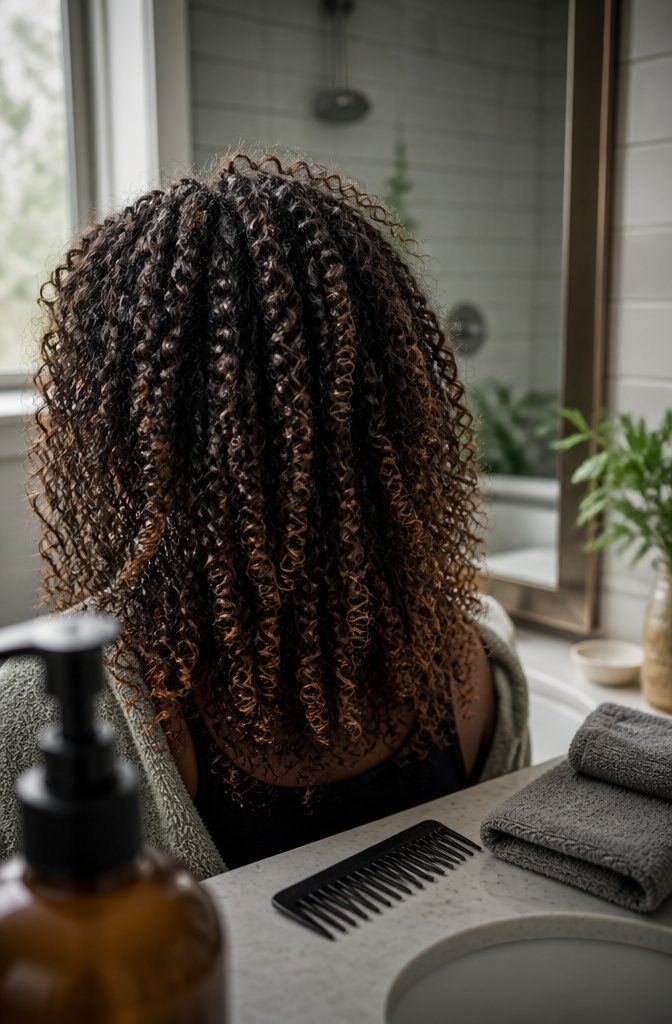
Every bend in a 3C corkscrew slows scalp oil down.
On straight hair that oil slides to the ends. On tight curls it stalls along the way, so the ends go dry first, shine fades, and dry strands turn brittle enough to snap.
3C also tends toward high porosity: it absorbs water easily but struggles to hold it. Humidity swings, friction and constant restyling push that dryness into frizz.
Rough detangling does the most avoidable harm. Wet 3C curls clump and knot, and dragging a brush through them breaks hair that was already thirsty.
Build a 3C Routine
Carol’s Daughter puts the core of it in one line:
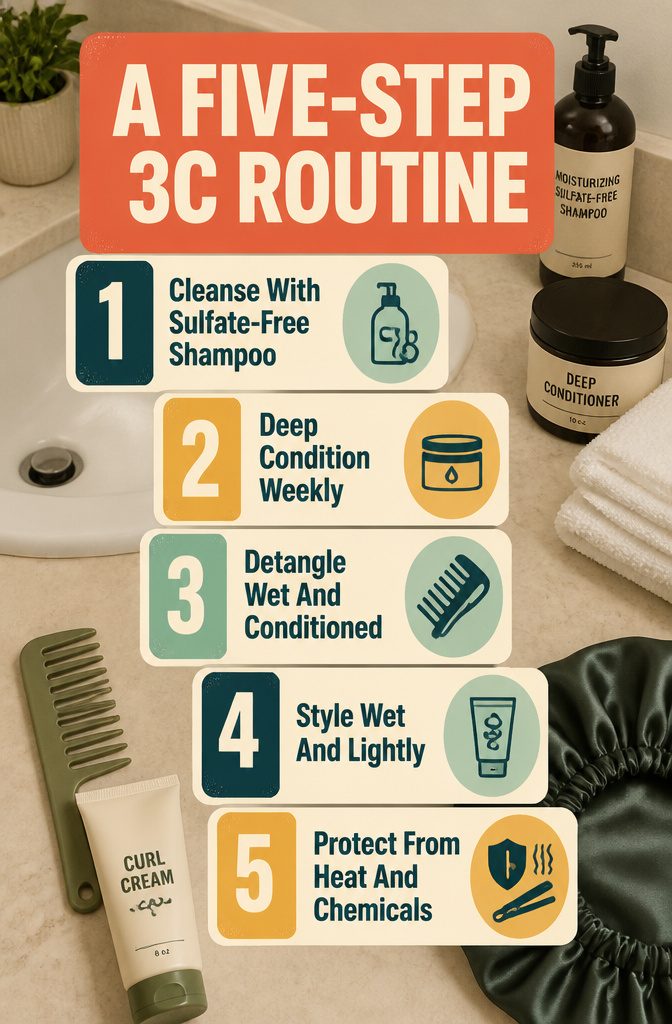
3C hair needs significant moisture, sulfate-free cleansing, regular deep conditioning, and gentle handling.
Every step below serves one of those four.
- Cleanse with a moisturizing, sulfate-free shampoo. Schedules range from once or twice a week to every 1–2 weeks, so judge by dryness and buildup, and co-wash midweek if needed.
- Condition after each wash, then deep condition once a week for 10–20 minutes.
- Detangle only while hair is wet and conditioned, using fingers or a wide-tooth comb.
- Style wet with a leave-in or curl cream, and go light so curls don’t get weighed down.
- Limit heat and chemicals, use a protectant if you heat-style, and cover hair with satin at night.
Styles That Define Curls
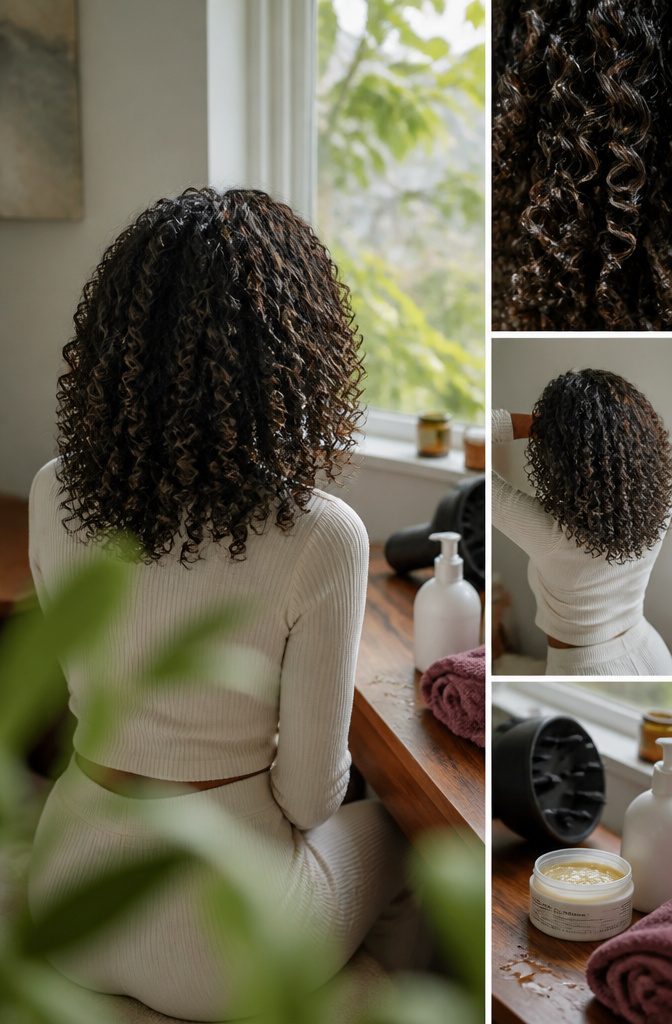
A wash-and-go takes ten to twenty minutes and lets curls dry into their natural corkscrew shape without rewetting or restyling between washes. Apply leave-in conditioner and gel to damp hair, scrunch, and air-dry.
The gel holds the curl and cuts down on frizz, though you give up some softness in exchange for definition. I reach for this when morning time is tight and the curl pattern can carry the look on its own.
Twist-outs and braid-outs stretch the curl and reduce shrinkage. Twist or braid damp hair in sections with a curl cream, leave it in four to six hours or overnight, then unravel.
The result shows more length than a wash-and-go and the definition lasts two to three days, making this a lower-manipulation choice once the initial styling is done.
Finger coils work the same way but take longer, since you’re winding each curl individually around your finger.
Protective styles like box braids, faux locs, or high buns keep hands off the hair for days or weeks at a time, which cuts breakage and gives curls a rest from daily product and combing.
You’ll spend more time on installation and have a harder time moisturizing your scalp between appointments.
Products and Tools
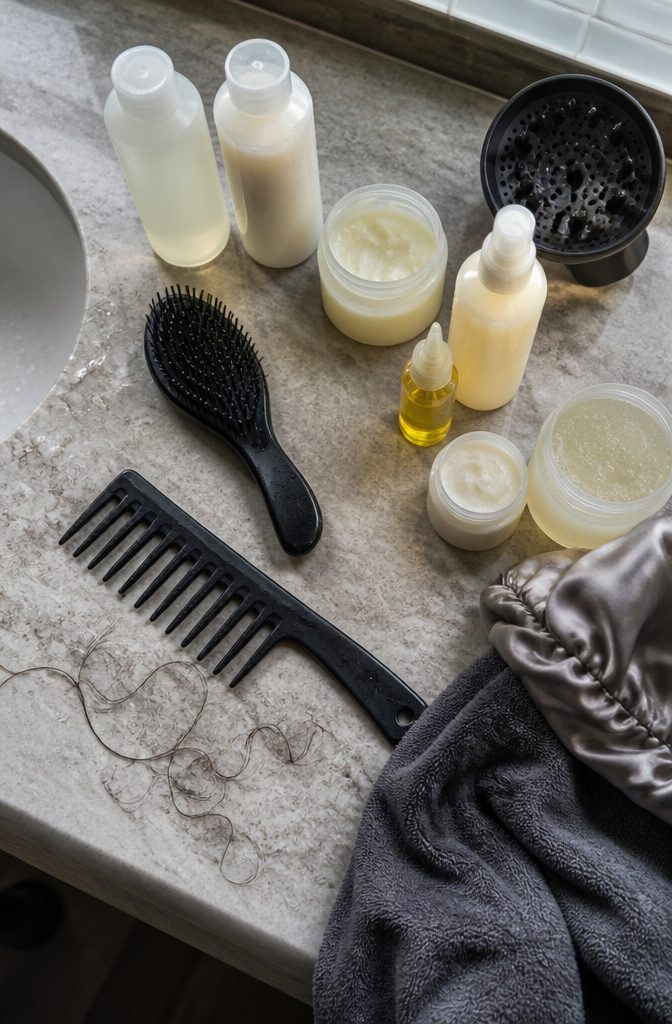
A 3C kit stays short, and nearly every item fights dryness.
- Cleanser: sulfate-free shampoo, with a co-wash between shampoos.
- Conditioner and mask: a rich conditioner, plus a weekly deep conditioner or protein-rich mask.
- Leave-in and oil: the leave-in goes on first, then an oil such as argan, jojoba or coconut to seal.
- Cream and gel: I’d pick light creams and gels with humectants like glycerin, which define without weighing curls down or leaving a crunch.
- Detangling: a wide-tooth comb, fingers or a detangling brush, on wet, conditioned hair, ends first.
- Drying: a diffuser on low heat, with heat protectant.
- Nights: sleep on satin.
Brand mentions, each as the brand’s own pick: Davines names LOVE Curl Shampoo and OI Oil, Carol’s Daughter its Black Vanilla line, and Prose lists a curl cream from $27.20 for 5.1 fl oz.
Protect Curls at Night

A regular cotton pillowcase creates friction against the hair shaft, and 3C curls already tangle easily, so by morning that drag shows up as frizz and breakage.
Satin or silk cuts that friction and the moisture loss that comes with it, whether it’s a pillowcase, a scarf or a bonnet.
I’d start with the bonnet or scarf, because it protects your hair even when you roll off the pillow.
The routine is short.
Spritz a leave-in conditioner to hold moisture overnight, then pineapple: loosely gather your curls at the crown with a satin scrunchie so the spirals don’t get squished. Done loosely, it preserves definition until morning.
Porosity Changes the Plan
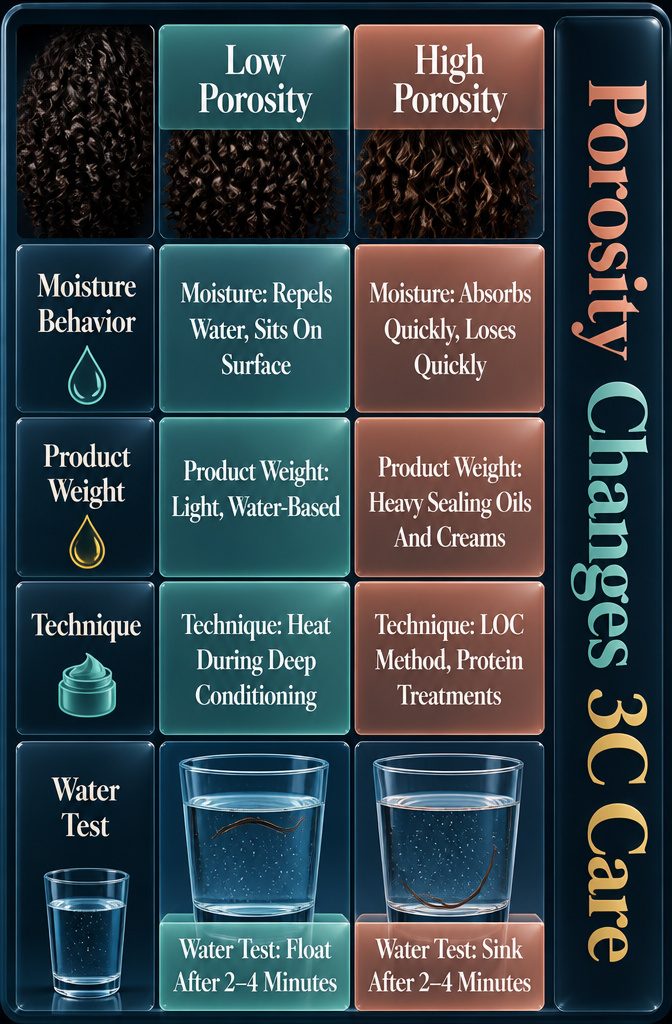
Hair porosity decides how easily moisture gets in and how long it stays. Low-porosity 3C hair resists water, so products tend to sit on top instead of sinking in.
The fix is lighter formulas and heat during deep conditioning to help ingredients penetrate. High-porosity hair pulls moisture in fast but loses it just as quickly, which leaves curls dry by midday.
For that, heavier sealing products work better, along with proteins and the LOC method: liquid first, then oil to lock it in, then cream to define.
The water-glass test gives you a rough read. Drop a clean strand in a glass of water and wait 2–4 minutes.
If it floats, porosity is low; if it sinks, it’s high. Sources disagree on what 3C hair typically is.
Some say low, others say high, and a few note that needs vary too much to generalize. Test your own hair instead of assuming.
| Porosity | Moisture behavior | Product weight | Technique |
|---|---|---|---|
| Low | Repels water, products sit on surface | Light, water-based | Heat during deep conditioning |
| High | Absorbs quickly, loses quickly | Heavy sealing oils and creams | LOC method, protein treatments |
Shrinkage, Length and Trims
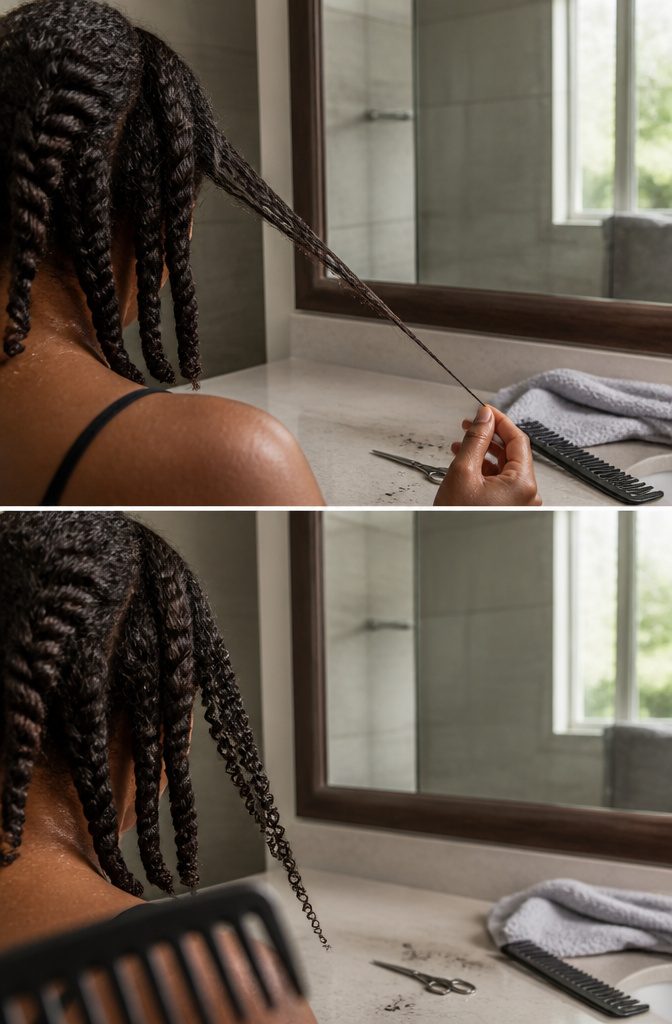
Wet 3C hair can look 40 to 60 percent shorter than its stretched length, and about 50% is the figure you’ll see most.
Braid-outs, twist-outs or banding pull it back out if the shrinkage bothers you. Your hair is still growing, since curls gain length like any other texture.
What costs you inches is breakage, so I’d start with detangling: work through damp, conditioned hair with a wide-tooth comb or your fingers. Trims come next, because split ends travel up the shaft.
Trim every 8–12 weeks for 3B–3C hair, and sooner if you notice tangled ends, thin ends, knots or extra shedding. Healthy ends also sharpen curl definition.
Frequently Asked Questions
What is type 3C hair?
Type 3C is the tightest of the type 3 curl patterns: springy, densely packed corkscrew ringlets with a lot of volume.
Sources usually compare the curl to the width of a pencil, and it sits just above type 4 on the curl scale. Descriptions of exact size and texture vary, so treat them as a range.
How do I know if I have 3C hair?
Let your hair air-dry with little product or handling, then hold a ringlet next to a pencil.
3C corkscrews match that width, roughly 6–8 mm. Check several sections, since one head often holds more than one pattern, and go with the pattern most of your strands show.
What is the difference between 3B and 3C hair?
Curl size separates them.
3B ringlets are about marker-sized and looser, while 3C forms tighter, denser, pencil-width corkscrews. To tell which you have, compare a dry ringlet against a marker and a pencil, and expect some overlap on mixed heads.
What is the difference between 3C and 4A hair?
4A is tighter: crochet-needle-size S-shaped coils versus pencil-width corkscrews for 3C.
Shrinkage is about 75% for 4A against about 50% for 3C, and 4A reads as very dense where 3C is dense. The line between the two can be subtle, because both show spiral definition and shrinkage.
How often should I wash 3C hair?
Anywhere from once or twice a week to every 1–2 weeks works, so let dryness and buildup decide.
Use a moisturizing, sulfate-free shampoo, and co-wash midweek if your hair needs a refresh. Sources give different schedules because needs vary from head to head.
Is type 3C hair rare?
No reliable global figure says how common 3C is, so any rarity claim is a guess. The pattern appears across ethnic backgrounds, and prevalence varies by population.
What ethnicity has 3C hair?
3C occurs naturally across many backgrounds, including people with African, Latin American, Middle Eastern and mixed ancestry. Curl pattern alone can’t identify anyone’s ethnicity, since natural hair varies widely within every population.
How do I prevent breakage in 3C hair?
Keep hair moisturized and handle it gently: detangle only when it’s wet and conditioned, using your fingers or a wide-tooth comb, and deep condition weekly.
Trim every 8–12 weeks, limit heat and chemicals, and sleep on satin to cut friction. Breakage, not slow growth, is what costs most people length.