4A wins if you want volume and are willing to layer moisture every few days, but 3C is easier to keep defined with lighter products and less effort.
The flip happens at shrinkage: 4A can lose half its stretched length or more, so hair that measures long when pulled can read short on your head, while 3C hangs in visible spirals.
Curl Pattern and Size
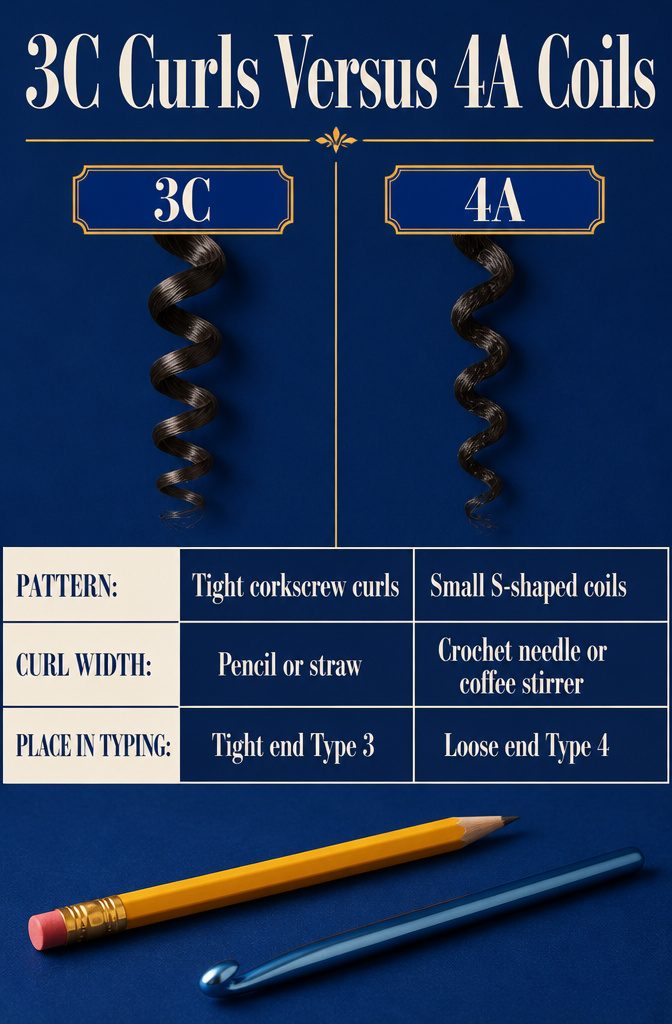
3C sits at the tight end of Type 3 and 4A at the loose end of Type 4, so the two meet right where curls turn into coils.
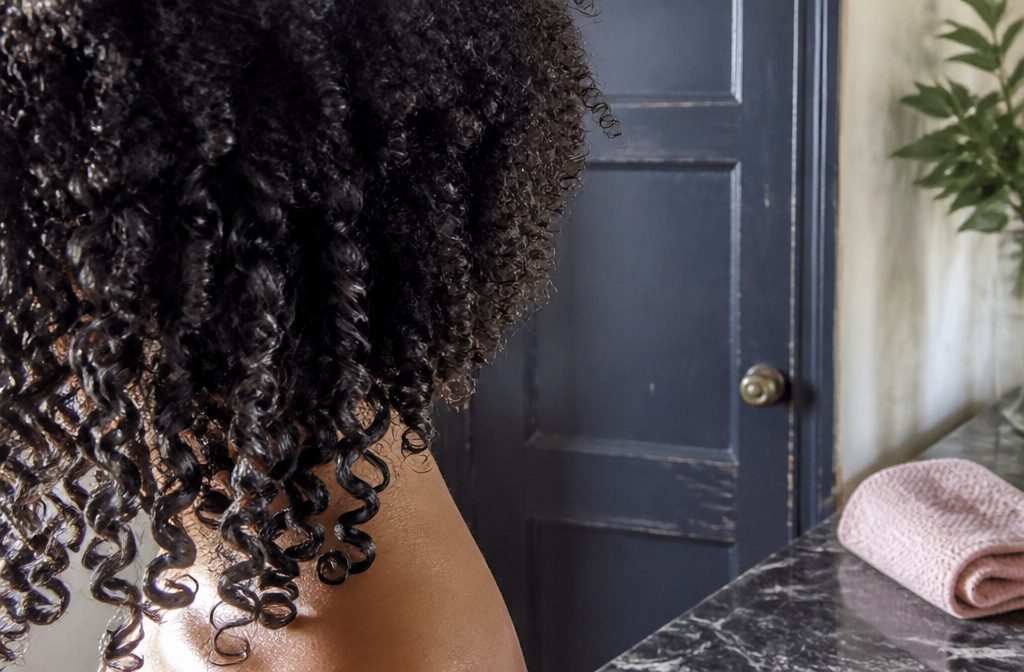
A 3C curl is a corkscrew, and a 4A curl is a small S-shaped coil. Width backs that up.
| 3C | 4A | |
|---|---|---|
| Pattern | Tight corkscrew curls | Small, tightly wound coils with an S shape |
| Curl width | Pencil or straw | Crochet needle or coffee stirrer |
| Place in typing | Tight end of Type 3 | Loose end of Type 4 |
I’d judge by width before anything else, since a photo can flatter either one.
Shrinkage and Growth Direction
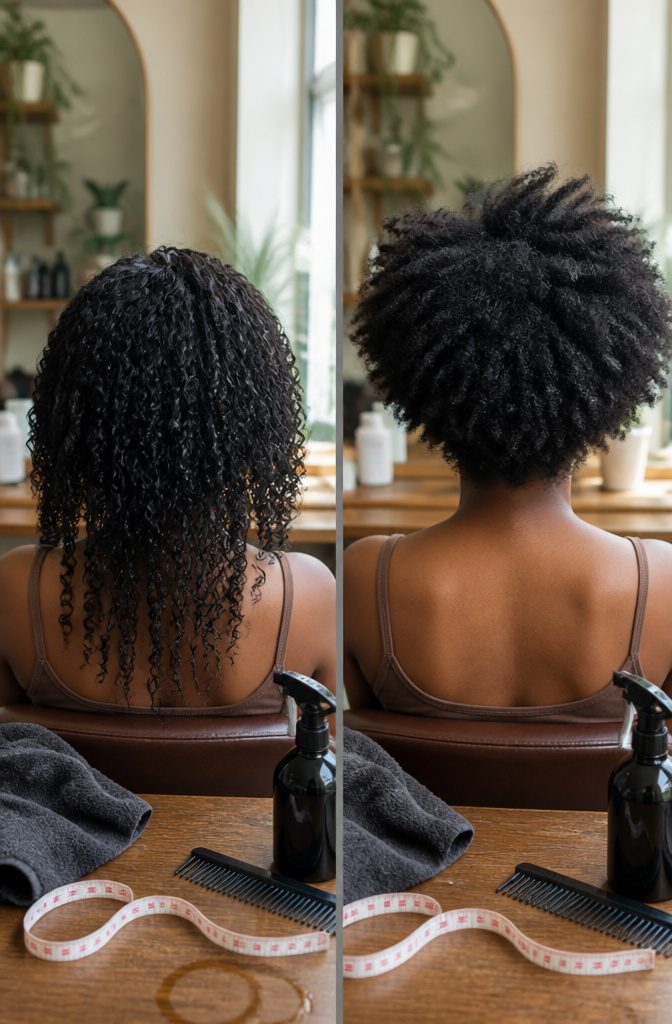
Both types shrink as they dry, but 4A shrinks harder: it can lose half its stretched length or more, so hair that is long when pulled straight can read as much shorter on your head.
3C shrinks noticeably too, yet the curls keep falling downward, so the real length stays easy to see.
Direction changes the silhouette as much as the length does. 4A grows outward and upward, building width and lift before gravity gets a say.
3C hangs, lying along the neck and shoulders in spirals. A wash-and-go on 3C shows length and a defined drop, while the same routine on 4A shows fullness and shape.
Porosity, humidity and product choice all shift how much shrinkage you see, so I’d judge your own pattern across several wash days, not one.
Definition, Texture and Overall Appearance
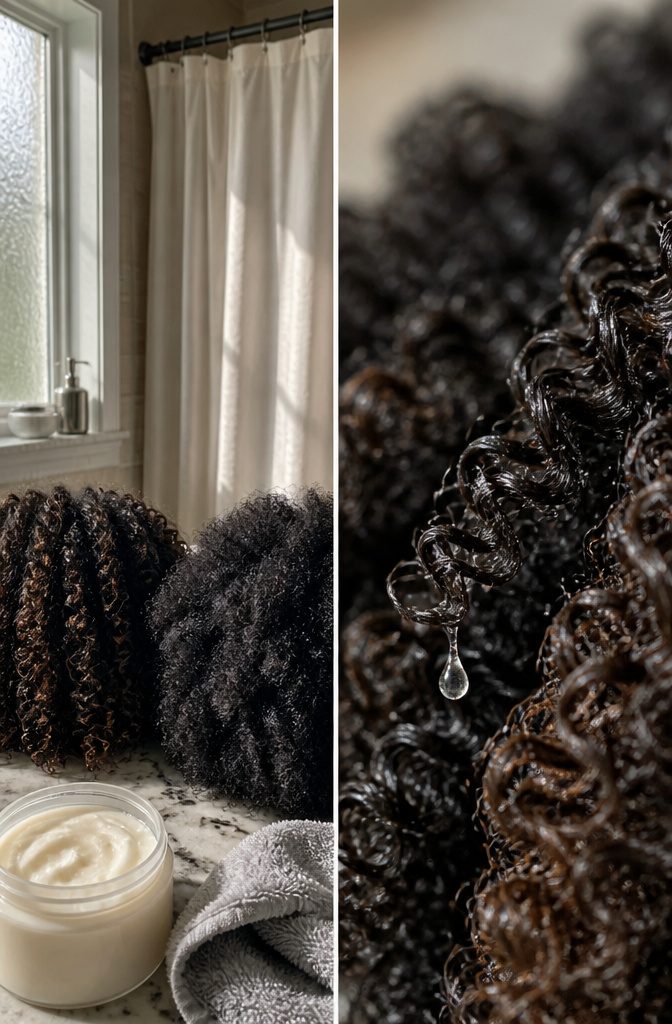
From a few feet away, 3C reads as a mass of defined ringlets with plenty of movement. 4A looks fuller, more compact and rounder.
Up close, 4A is typically soft to the touch and easy to define, but only while it’s moisturized. Dry 4A can blur, and on the second or third day after washing it settles into a softer, fluffier finish.
3C keeps its pattern visible wet or dry, though dry strands can look tighter than they really are.
Wet them down or work in a leave-in, and the corkscrew shape comes back. I’d judge your pattern on freshly moisturized hair, since a dry day-three head can pass for the wrong type.
Care and Product Needs
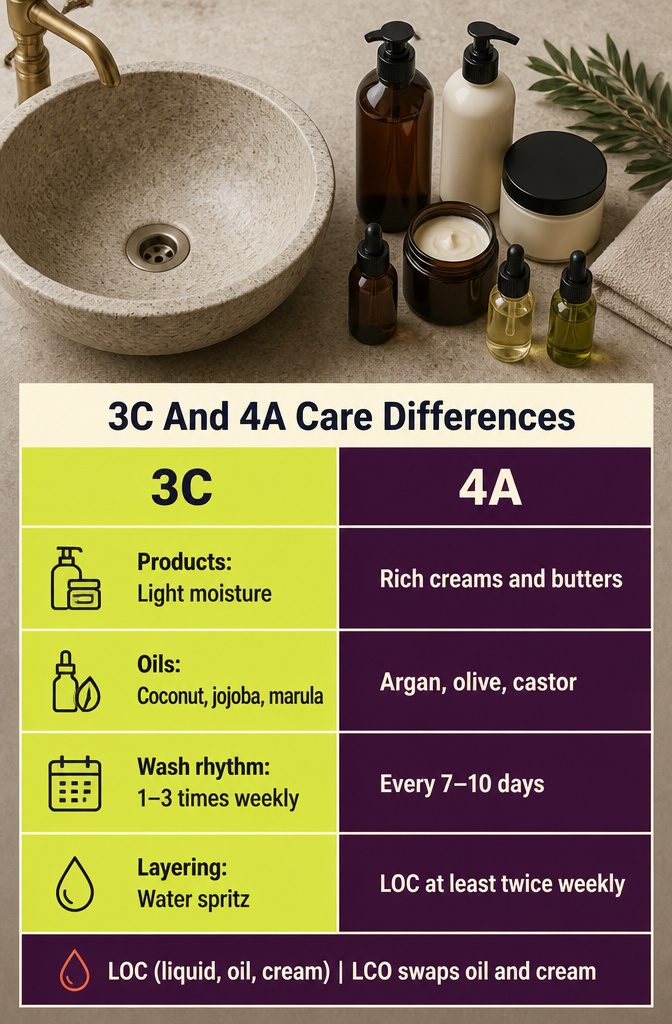
3C curls stay defined when moisture is light: heavy products weigh them down.
A water spritz with coconut oil and aloe vera tops up hydration through the day, and black seed, jojoba or marula oil work well alongside it. Washing 1–3 times a week suits 3C.
4A is the reverse. It wants richer creams and butters, sealed with argan, olive or castor oil.
Wash every 7–10 days as a general guideline, and layer products with the LOC method (liquid, oil, cream) at least twice a week. LCO simply swaps the order of oil and cream.
Finger detangle 4A with a slip product, working in sections so tangles never pile up.
Styling and Extensions
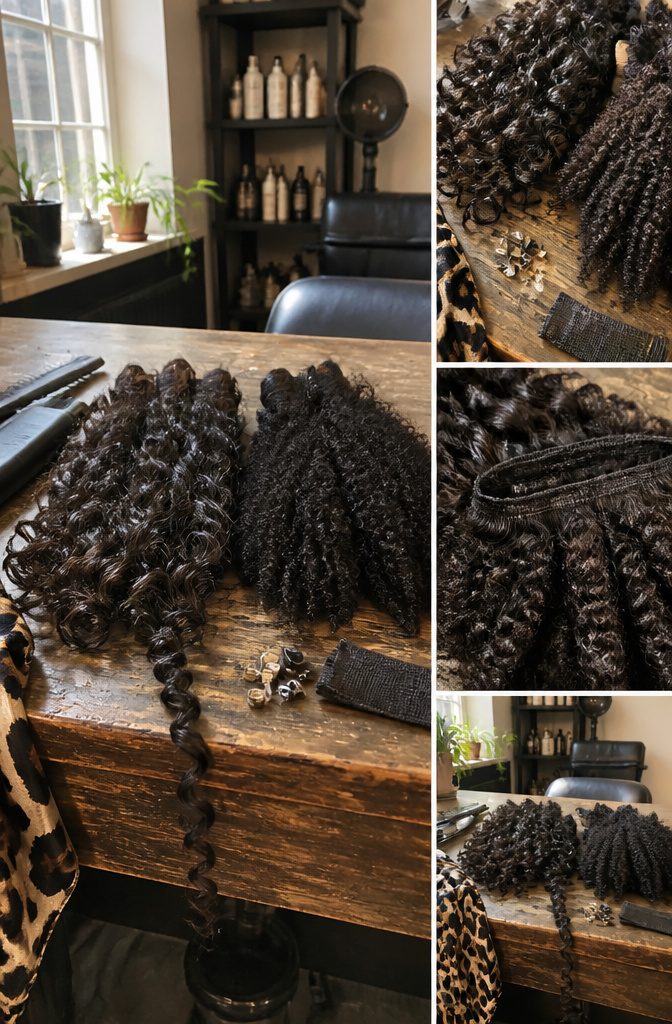
Twist-outs, braid-outs, puffs and wash-and-gos work on both types, and Bantu knots can set either one for a twist-out or braid-out. Extensions are where the two types split.
3C blends with deep curly, corkscrew curly or tight curly, which have defined ringlets rather than coils. 4A does better with kinky curly or coily, and kinky straight if you mostly wear your hair stretched.
Match your hair in its natural, unstretched state, not the blown-out version. 4A is often very full, so thin bundles look sparse beside it.
Sew-ins and clip-ins use weft hair and add length and fullness to both. Microlinks attach with tiny beads, no glue or heat, but I’d only book a stylist experienced with textured hair, since too much tension stresses fragile coils.
How to Tell Which Type You Have
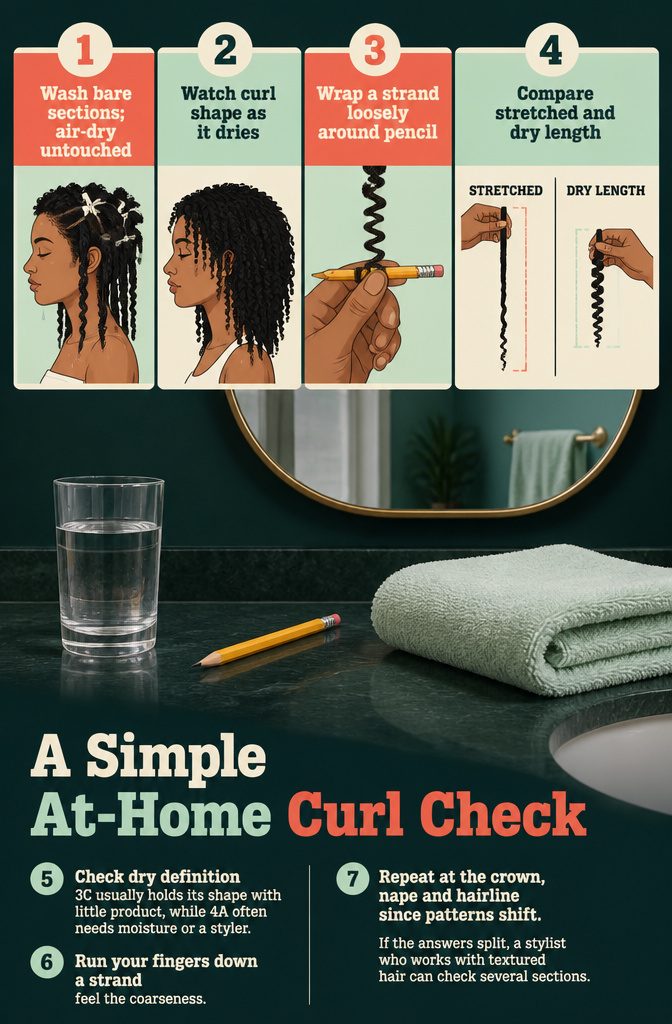
- Wash with no product and let a few sections air dry untouched. This is the wash-and-go test, and styler skews every result after it.
- Watch the hair as it dries. Note the curl’s shape and tightness, and whether it hangs down or grows out from the scalp.
- Wrap a strand loosely around a pencil. A curl that matches the pencil or runs slightly wider leans 3C; a noticeably tighter curl leans 4A. I trust this step over the mirror.
- Compare a stretched section with its dry length. Heavy shrinkage points to 4A.
- Check dry definition. 3C usually holds its shape with little product, while 4A often needs moisture or a styler.
- Run your fingers down a strand and feel the coarseness.
- Repeat at the crown, nape and hairline, since patterns shift. If the answers split, a stylist who works with textured hair can check several sections.
Mixed Patterns and What Hair Typing Does Not Show
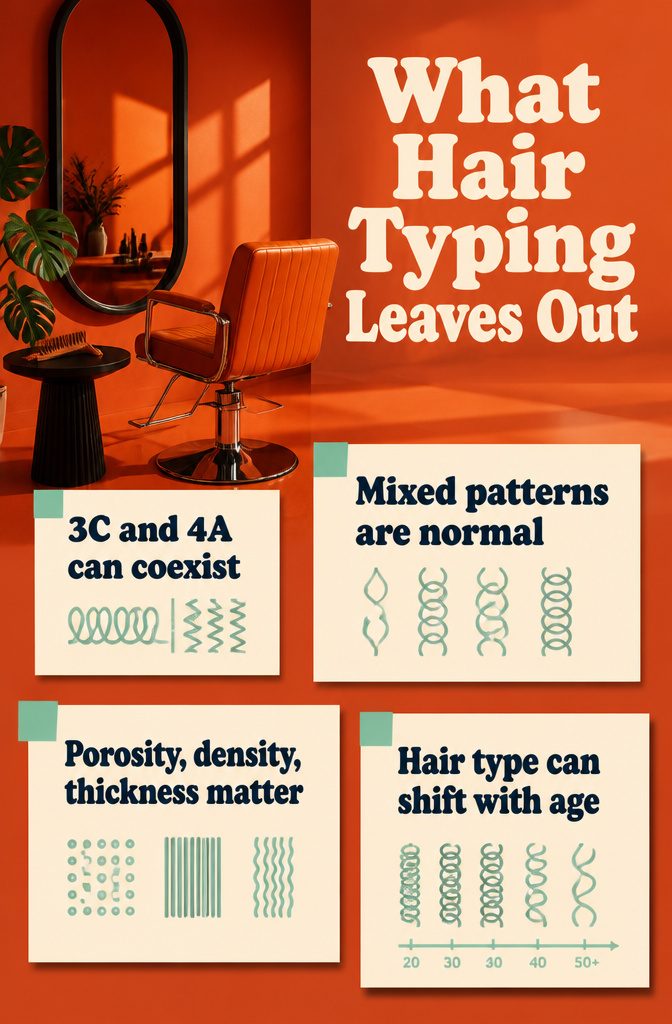
Most heads carry more than one pattern, so 3C in one section and 4A in another is a normal head of hair, not a typing mistake.
Think of the two as neighbors: 3C is the tight end of curly, and 4A is the loose end of coily.
Blended types are common, and the same hair can read differently depending on how it was washed, styled or dried.
The number also leaves out strand thickness, porosity and density, which often shape how your hair behaves more than the label does. Two women who are both 4A can need very different products.
I treat the type as a starting point and let those three traits settle the rest. Hair type can also shift with age, so a label you picked years ago may no longer fit.
Frequently Asked Questions
What is the difference between 3C and 4A hair?
3C has tight corkscrew curls about the width of a pencil or straw, while 4A has smaller S-shaped coils the width of a crochet needle or coffee stirrer.
4A shrinks more heavily, can lose half its length or more when dry, and needs richer creams and butters to stay defined. 3C keeps its ringlet shape with lighter moisture and hangs downward, while 4A grows outward and builds width.
How do I know if my hair is 3C or 4A?
Wash your hair with no product and let it air dry untouched, then wrap a strand loosely around a pencil.
A curl that matches the pencil or runs slightly wider is 3C; a noticeably tighter curl is 4A. Check whether it hangs down or grows outward, and measure how much it shrinks when dry.
Can you have both 3C and 4A hair?
Yes, most heads carry more than one pattern, so 3C in one section and 4A in another is normal. The two types sit right next to each other in the hair typing system, so blended textures are common.
What hairstyles work for 3C and 4A hair?
Twist-outs, braid-outs, puffs, wash-and-gos and Bantu knots work on both types. Protective styles like sew-ins and microlinks also suit both, though 4A needs a stylist experienced with textured hair to avoid tension damage.
Does 4A hair shrink more than 3C hair?
Yes, 4A can lose half its stretched length or more as it dries, while 3C shrinks noticeably but keeps its length visible. 4A also grows outward and upward, so the silhouette reads fuller and rounder instead of hanging down.
Can 3C hair look like 4A hair?
Yes, dry 3C hair can look tighter and may pass for 4A on day three after washing. Wet it down or work in a leave-in, and the corkscrew shape comes back.
What extensions blend with 3C hair?
Deep curly, corkscrew curly or tight curly extensions blend best because they have defined ringlets rather than coils. Match your hair in its natural, unstretched state rather than the blown-out version.
What extensions blend with 4A hair?
Kinky curly or coily textures suit curly styles, and kinky straight works if you mostly wear your hair stretched. 4A is often very full, so thin bundles look sparse beside it.
What is the difference between 3B and 3C hair?
3B has springy ringlets that are looser and wider than 3C, while 3C sits at the tight end of Type 3 with dense corkscrew curls about the width of a pencil. 3C has more volume and a coarser texture than 3B.
How to maintain 3C 4A hair?
3C needs light moisture like a water spritz with coconut oil or aloe, washed 1–3 times a week, while 4A wants richer creams and butters sealed with argan, olive or castor oil, washed every 7–10 days.
Layer 4A products with the LOC or LCO method at least twice a week, and finger detangle in sections with a slip product.
Does 3C hair shrinkage?
Yes, 3C shrinks noticeably as it dries, though less than 4A. The curls keep falling downward so the real length stays easy to see, while 4A grows outward and can lose half its length or more.