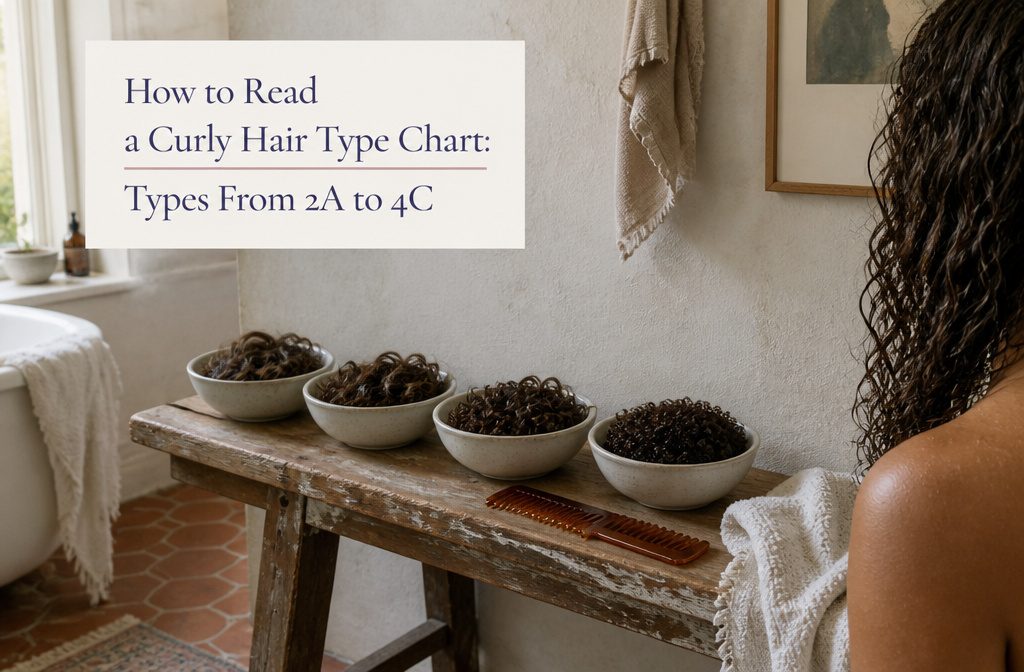
Reading the chart takes one wash day and no money: the number gives you the family (wavy, curly, coily) and the letter places you from loose A to tight C. Most people get the lookup wrong by expecting one answer.
Mixed patterns are normal, such as 3B ringlets at the crown over looser 3A underneath, so wet and dry hair can read differently.
How the Type and Letter System Works
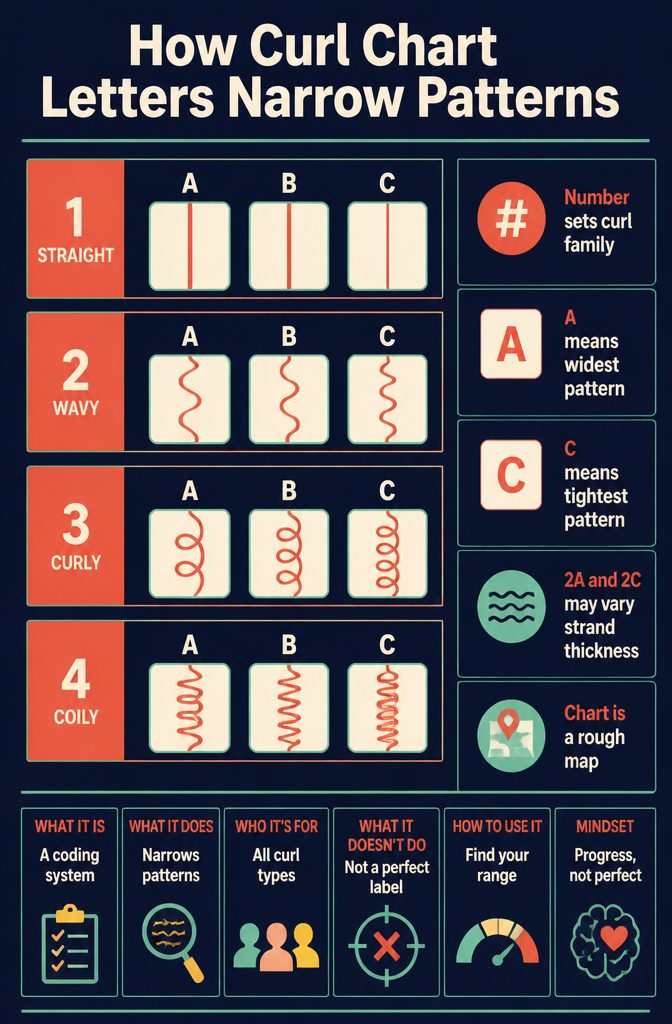
The number sets the family: Type 1 is straight, Type 2 wavy, Type 3 curly, Type 4 coily. The letter narrows it down.
A is the widest, loosest pattern in each type, B sits in the middle, and C is the smallest or tightest. A 3A loop is larger than a 3C corkscrew, and a 4A coil is more open than a 4C.
For Types 1 and 2, Ceremonia notes that the letters can also point to strand thickness, so a 2A and a 2C may differ in more than wave strength.
I treat the chart as a rough map, not a verdict. The number gives you the family, and the letter tells you how far along the loose-to-tight scale you sit.
1. Type 2A: Tousled Waves Close to the Scalp
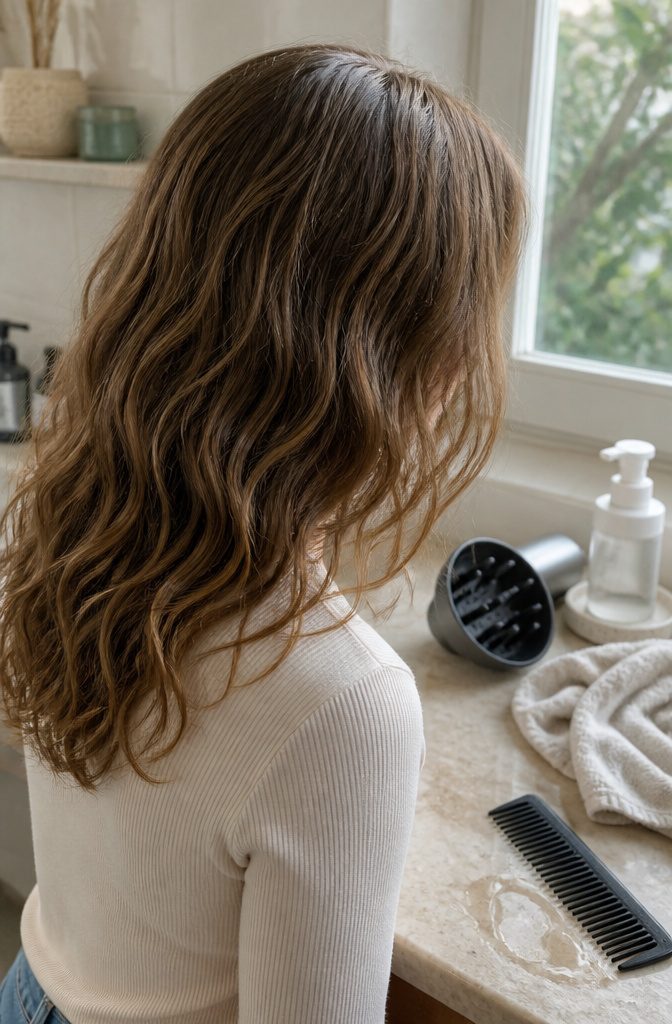
Type 2A sits closest to the scalp with the least volume and wave definition of any pattern on the chart.
The S-bend is loose and sits mostly from the mid-lengths down, so the roots stay flat. This is the pattern people mistake for straight hair that just needs better brushing, but it responds to technique.
I use lightweight mousse or a light gel on damp hair and scrunch upward from the ends.
Heavy creams flatten 2A waves in minutes. Air-drying works if you have time and the patience not to touch it, but diffusing on low heat gives more volume and hold when you need the waves to last past lunch.
Ceremonia notes that 2A and 2B hair can go every two to three days between washes, which matters when you’re deciding whether to invest time in styling or just throw it up.
The trade-off with 2A is longevity. Waves tend to drop throughout the day, especially at the crown where there is the least natural lift.
Diffusing helps, but this is still the pattern that flattens fastest under hats, headbands, or anything that presses the hair down while it is still setting.
2. Type 2B: Defined S-Waves from the Mid-Lengths
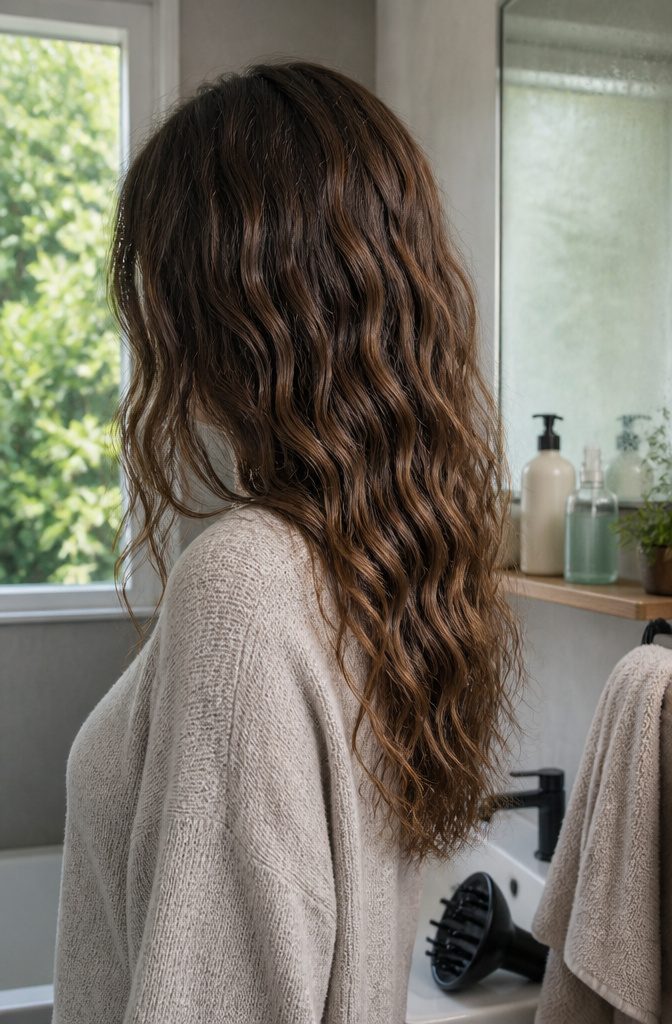
Type 2B sits right between tousled beach waves and true curls. The S-shape here is more defined than 2A and starts closer to the roots or mid-lengths, giving the hair more body and movement.
You’ll see the wave pattern form a few inches down from the scalp rather than just at the ends, and the texture carries a little more volume without touching the spring of 3A curls.
I find that sulfate-free cleansing keeps the wave intact without stripping the natural texture or adding frizz. Washing every two to three days lets the pattern hold without overloading the hair with product or drying it out between washes.
Lightweight curl cream or mousse works better here than anything heavy. Rich butters and oils designed for coily hair will flatten 2B waves and leave them limp against the scalp.
A light gel or curl-enhancing spray gives hold without weight, and scrunching product into damp hair before air drying or diffusing locks in the S-bend without disturbing it.
3. Type 2C: Strong S-Bends That Start at the Roots
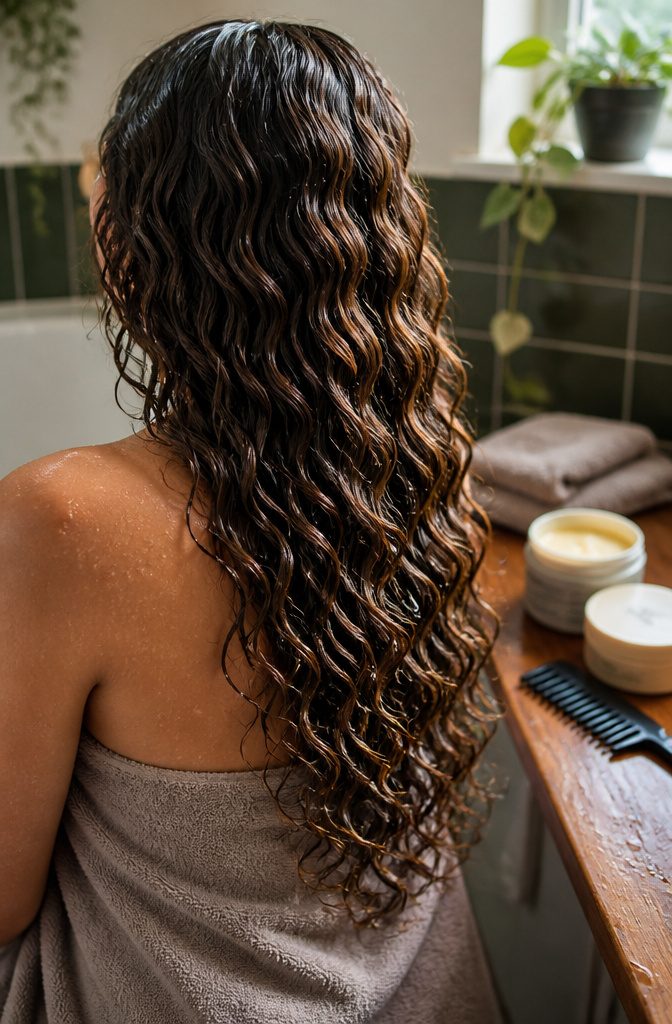
Type 2C sits right at the edge between wave and curl, with S-bends strong enough that they start forming at the roots instead of halfway down.
You get real body and volume that stands away from your scalp, and some of those S-shapes tighten all the way into loose ringlets by the time they reach your ends.
The pattern has enough structure to hold slightly heavier products without going flat, so you can reach for a cream or a gel that would weigh down 2A or 2B.
Wash every three to five days to keep the pattern defined without stripping natural oils, and work in a deep conditioner once a week.
The coarser texture and tighter bend mean moisture moves more slowly down the strand, so that weekly treatment keeps the mid-lengths and ends from getting dry and frizzy between washes.
4. Type 3A: Wine-Cork-Sized Loops
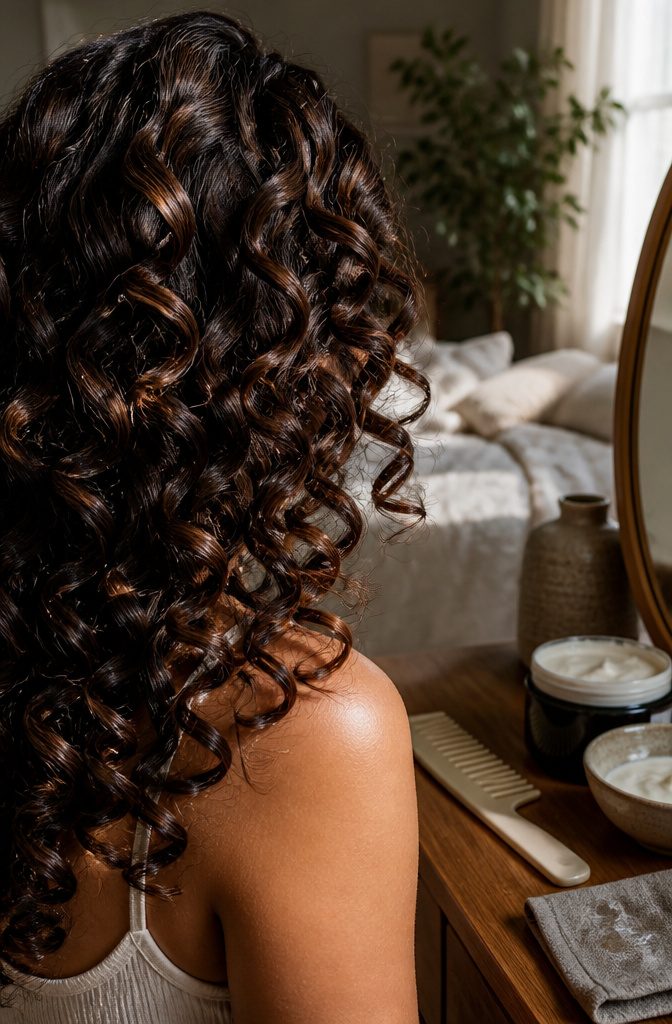
Type 3A curls form loose, wide loops about the size of a wine cork. They tend to be shiny, with broader spirals that start somewhere between mid-length and root depending on weight and product.
The curls clump naturally but dry out faster than waves, so hydration decides whether you get definition or a frizz halo.
3A strands tend to be shiny with broader, looser curls that have a diameter about the size of a piece of sidewalk chalk.
— Allure
That shiny surface comes with a trade-off: the cuticle is open enough to lose moisture quickly, so lightweight moisture matters more than heavy oils at this stage.
I’d wash once or twice a week and leave it there.
Allure pegs the range at one to two times weekly, Ceremonia recommends once per week for Type 3 overall, and co-washing with conditioner between full shampoo days keeps the scalp clean without stripping oils.
Use a sulfate-free shampoo when you do wash, since sulfates pull moisture out faster than these curls can replace it.
For styling, work curl cream or gel through damp hair from roots to ends, scrunch out the water, then step back.
Touching the curls after product goes in breaks up the clumps and starts frizz. Detangle carefully during conditioning, using a wide-tooth comb or your fingers rather than a brush that snaps the curl apart.
5. Type 3B: Index-Finger Ringlets
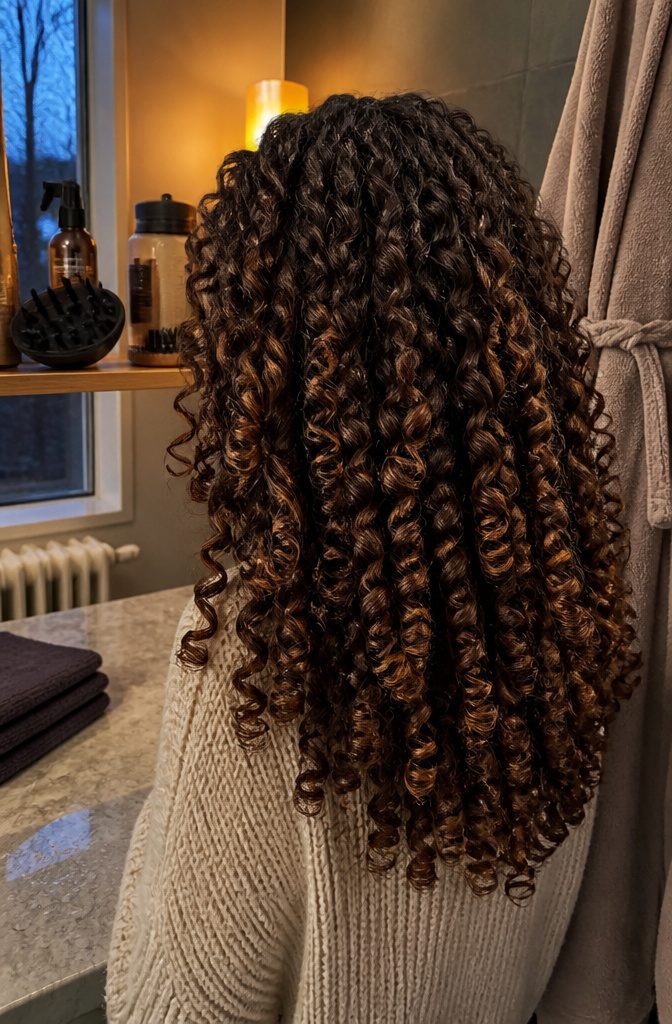
Type 3B sits right in the middle of the curl spectrum with springy ringlets about the diameter of your index finger.
The spirals are tighter than 3A but not yet corkscrew territory, and they bring more volume and bounce than looser patterns.
The challenge here is hydration.
Scalp oils struggle to travel down those curves, so the ends stay drier than the roots. That makes sulfate-free shampoos non-negotiable.
Sulfates strip moisture right when you need to keep it locked in the strand. Look for formulas with shea butter, olive oil, or tea tree oil to cleanse without drying out the curl.
Conditioning matters just as much. I recommend a deep treatment at least once a week with ingredients like avocado, castor oil, or chia.
Between washes, a leave-in conditioner with jojoba oil or honey keeps things soft without weighing down the spiral. For styling, a lightweight curl cream or gel defines the ringlet without stiffness.
Apply it to damp hair, then either air-dry or use a diffuser on low heat with a heat protectant. The diffuser speeds things up in winter when waiting all day is not realistic.
6. Type 3C: Tight Straw-Width Corkscrews
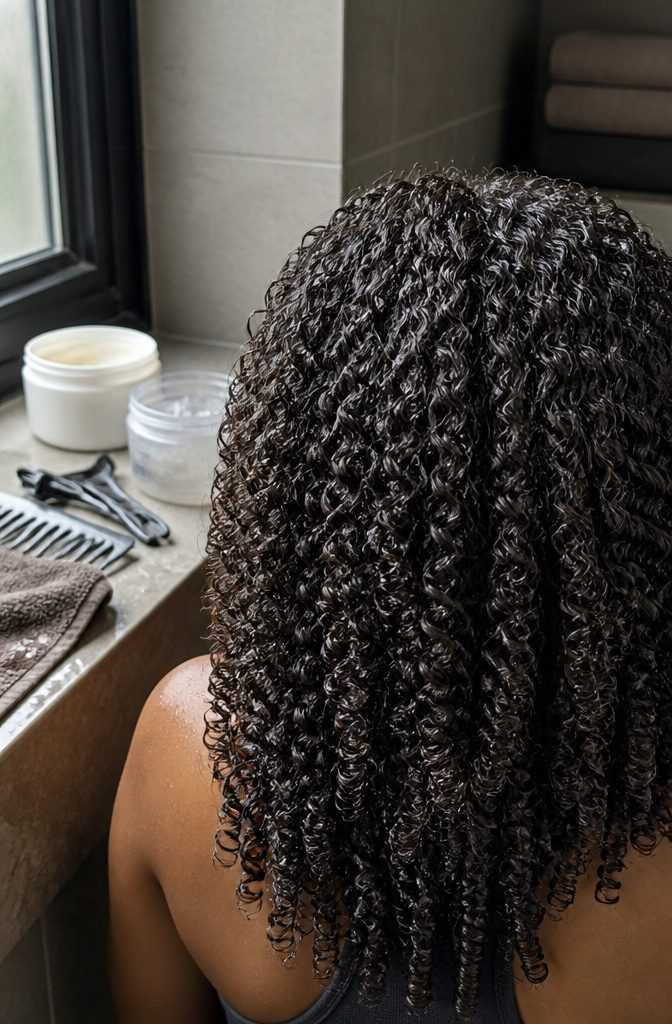
Type 3C sits at the tightest end of the curl spectrum, with corkscrew spirals about the circumference of a straw.
The curl clumps densely, which gives this pattern a lot of natural volume right from the roots. That density also means the scalp’s natural oil has a harder time traveling down each spiral, so dryness becomes the main challenge.
I look for sulfate-free cleansers here because anything harsher strips moisture the hair can’t afford to lose. A creamy co-wash works well when you need to refresh without over-cleaning.
After cleansing, conditioning matters more than it does for looser patterns. A weekly deep treatment keeps strands soft enough to detangle without breakage.
Styling products need more hold to define each corkscrew and prevent frizz. Layering a styling cream with a gel or mousse while the hair is soaking wet lets curls clump together and set faster.
The cream adds moisture, the gel locks the shape. Skip that step and the curls separate into frizz by midday.
7. Type 4A: Crochet-Needle S-Coils
Type 4A: Crochet-Needle S-Coils
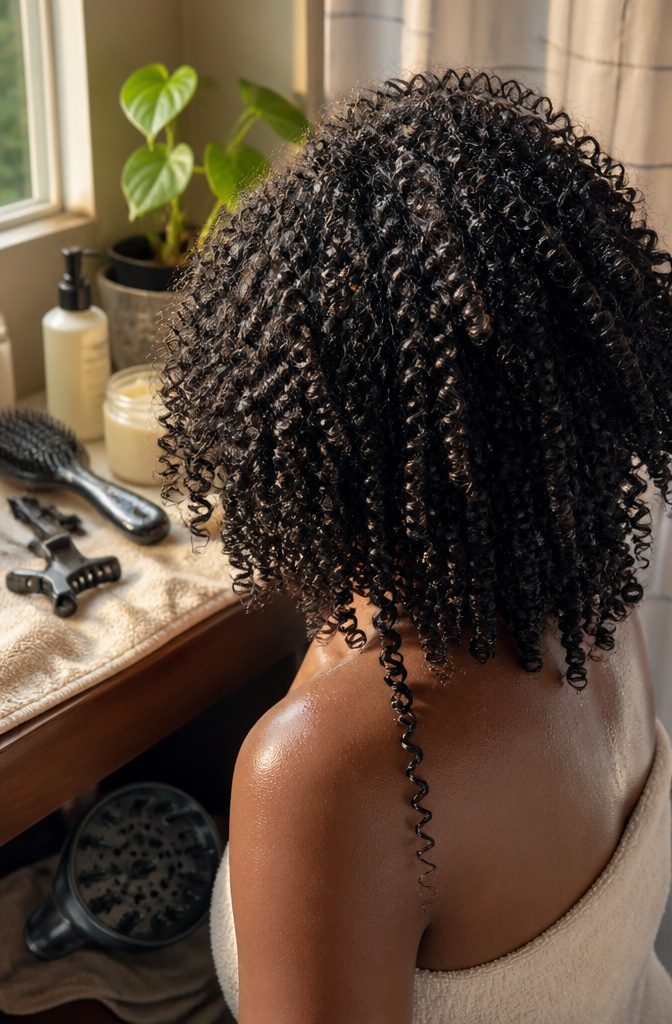
Type 4A gives you dense, springy S-pattern coils about the circumference of a crochet needle, with circular definition you can see when the hair is properly hydrated.
The spiral is visible, which sets it apart from 4B’s sharper zigzag. Shrinkage is real, but the coil structure holds its shape.
Hydration drives everything here. I recommend washing every seven days and clarifying once a month to strip buildup without overdrying.
Between shampoo days, co-washing with a cleansing conditioner keeps the hair clean while adding moisture back. Deep conditioning every wash day is non-negotiable, especially if you detangle wet.
Detangle carefully with a brush and sectioning clips, working through one small section at a time.
A curl cream layered over a leave-in moisturizer defines the coils without crunch. Diffuse to dry if you want extra body.
Protective styling and low-manipulation techniques cut down on breakage, which matters when you’re trying to retain length. Scalp massage helps stimulate blood flow, supporting stronger growth at the root.
8. Type 4B: Z-Shaped Bends with Sharp Angles
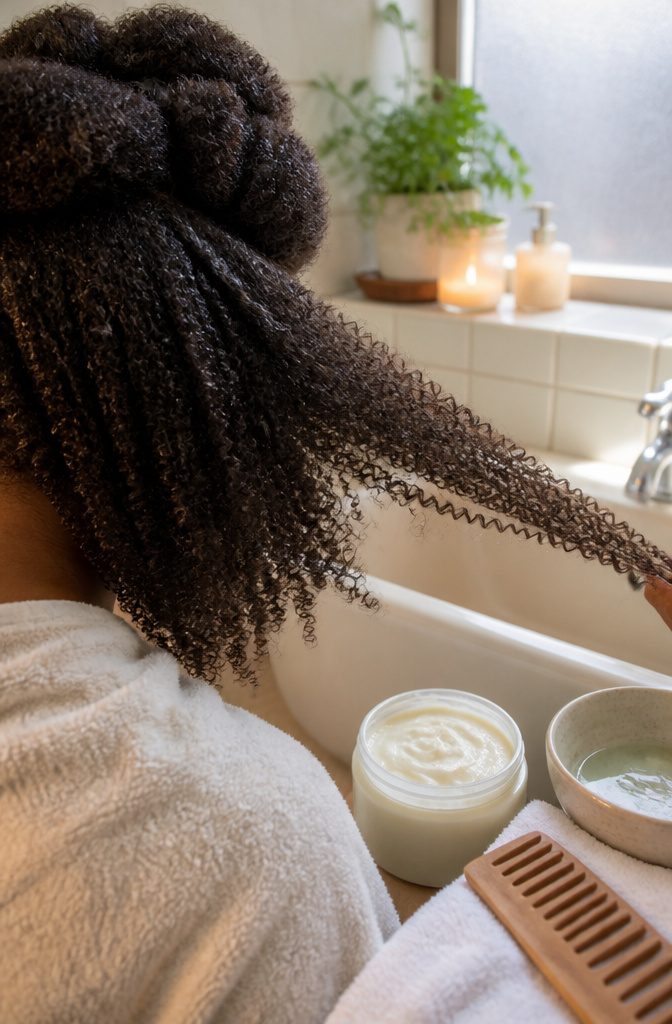
Type 4B bends in sharp angles like the letter Z rather than forming visible circles. The coils are tighter than 4A and less defined, with each bend creating a zigzag spring pattern similar to the coil inside a pen.
Because the curl structure folds back on itself so many times per inch, 4B is prone to dryness, breakage, and tangles.
Deep conditioning every wash is non-negotiable. I look for slippery moisturizing products that help with detangling, which is the biggest challenge on wash day.
Conditioning washes with coconut and castor oils keep the hair from being stripped during cleansing, though a hydrating shampoo once a month prevents buildup.
After washing, a deep moisture mask gives the slip needed to work through knots without snapping strands.
Protective styles minimize manipulation, which preserves length.
When you do detangle, work gently and avoid excessive heat. Stronger-hold stylers help combat natural shrinkage when defining the pattern.
9. Type 4C: The Tightest Pattern with 70–75 Percent Shrinkage
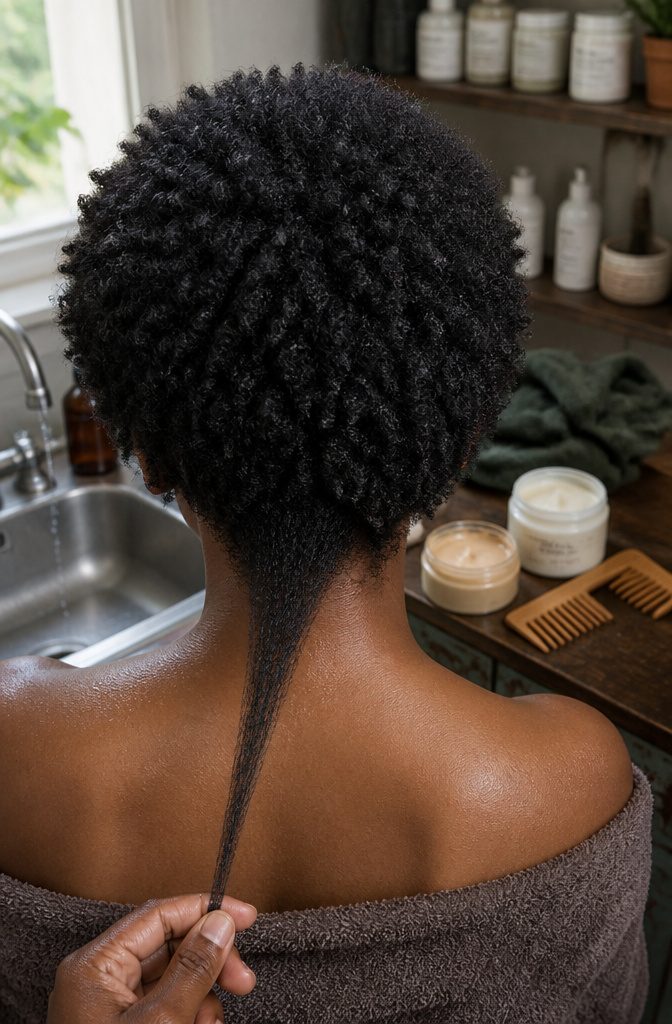
Type 4C sits at the tightest end of the coil spectrum. The pattern forms Z-shaped coils so small they often look undefined rather than presenting the neat spirals you see at 3A or 3B.
What sets 4C apart is 70–75 percent shrinkage, which means a shoulder-length head of hair can spring back to chin-length or shorter when dry.
That elasticity is healthy, but it makes length retention feel like a losing game if you don’t adjust how you handle it.
The same tight coil structure that creates all that shrinkage also makes 4C the most fragile curl type.
Each strand bends dozens of times per inch, and every bend is a potential break point when you detangle or manipulate. Protective styles and gentle detangling are non-negotiable if you want to keep length.
On wash day, Vogue recommends skipping shampoo most of the time and reaching for a conditioning co-wash that won’t strip moisture. Once a month, use a hydrating shampoo to clear buildup, then follow with a deep conditioner every single wash.
Slippery, moisturizing products make detangling less of a fight, and stronger-hold gels keep the definition you worked for from disappearing as the hair dries.
How to Identify Your Pattern
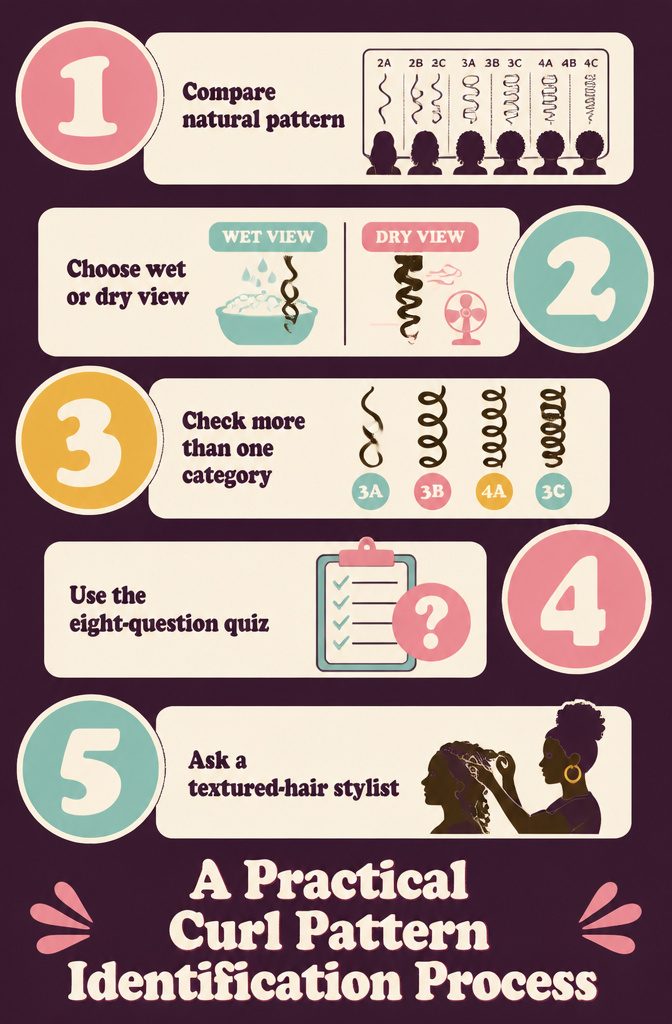
Start by comparing your natural curl pattern to the chart, ideally after washing. Advice on identifying your curl pattern splits into two camps, and I found sources on both sides.
One approach says to look at hair sopping wet, right after you’ve rinsed out shampoo, when the curl is at full tension and hasn’t started to dry into frizz.
The other says to wash, skip all product, and let your hair air-dry completely so you’re seeing the shape it settles into on its own. Both have merit.
Wet hair shows the tightest version of your pattern, which matters for porosity and density calls. Dry hair shows what you’re actually working with each morning.
Most people land in more than one category, and that’s normal. You might have 3B ringlets at the crown and looser 3A waves underneath, or 4A coils at the roots that stretch toward 3C mid-shaft.
If the chart alone isn’t clearing it up, an 8-question quiz can narrow the field, or you can ask a stylist who works with textured hair to map your mix and build a care plan around it.
Most People Have Mixed Patterns
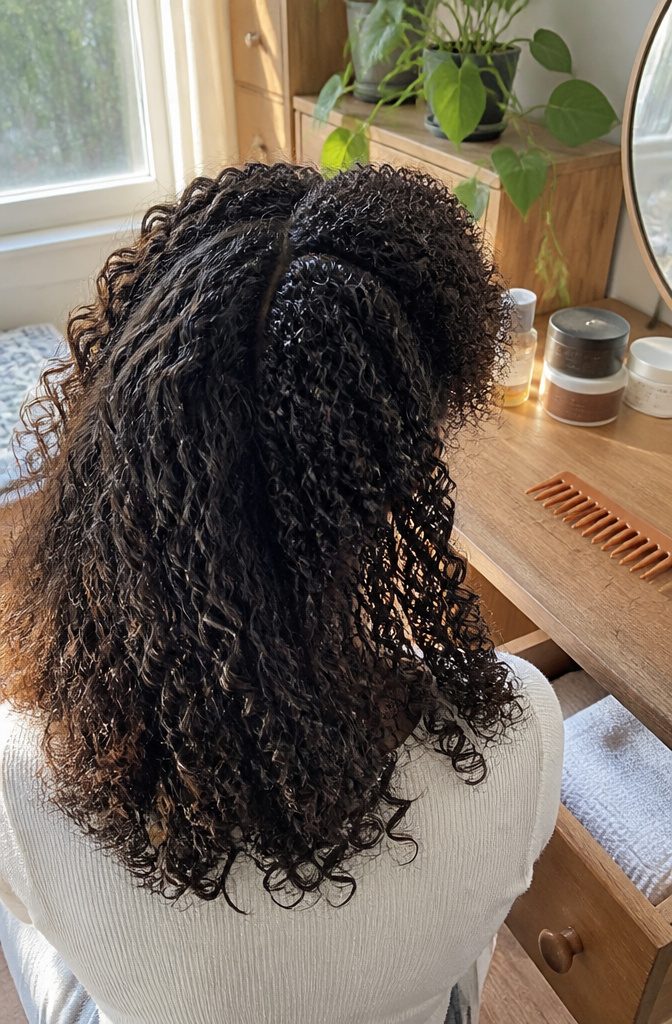
No head of hair fits just one box. Allure, Vogue, Pantene, and Only Curls all confirm the same thing: most people see more than one curl pattern on their head.
You might have 3A spirals at the crown and looser 2C waves underneath, or tight 4B coils in back with softer 4A texture around the hairline.
The chart gives you a starting point to name what you see and narrow down which products and techniques make sense, but it was never meant to be a perfect label.
I treat it more like a reference than a rulebook. If you land somewhere between two types or spot three patterns when you section your hair, that’s normal and actually what makes textured hair interesting to work with.
Strand Texture, Porosity, and Other Factors That Matter
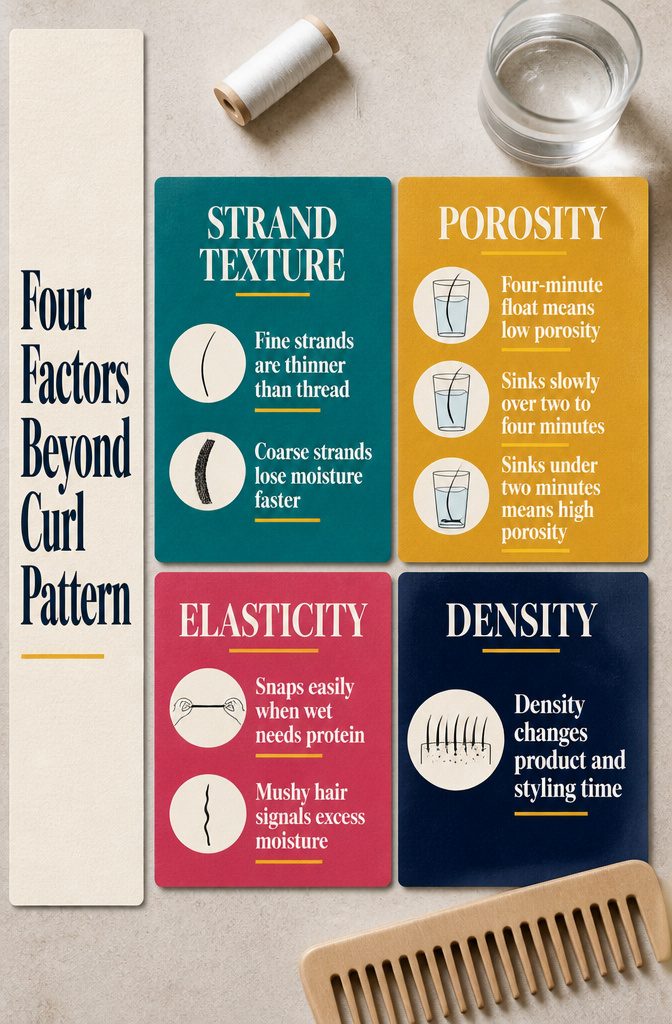
The curl pattern chart tells half the story. The other half is four factors that decide how your hair responds to moisture, whether it holds a style, and which products actually do what their labels promise.
Start with strand texture, which describes the thickness of a single strand.
If your strand is thinner than a piece of sewing thread, it’s fine. Thicker than the thread puts you in the coarse camp, and matching the thread is medium.
Fine hair tends to be less porous, so oil sits on top and looks greasy faster than it does on coarser textures. Coarse strands lose moisture and dry out quicker.
Porosity measures how quickly your hair absorbs and loses moisture, tied directly to the health of the cuticle.
If a strand floats for four minutes or more in water, you have low porosity. It sinks slowly over two to four minutes for medium porosity, and under two minutes signals high porosity.
High-porosity hair gets wet fast but loses that moisture just as fast. Low porosity hair repels water and lets products sit on the surface.
Elasticity is how much a strand stretches under tension before it breaks. If your hair snaps easily when wet, it needs protein.
If it feels mushy and limp, you’ve overdone the moisture. Density refers to how many strands you have per square inch of scalp, which affects how much product you need and how long styling takes.
Why Curl Patterns Change
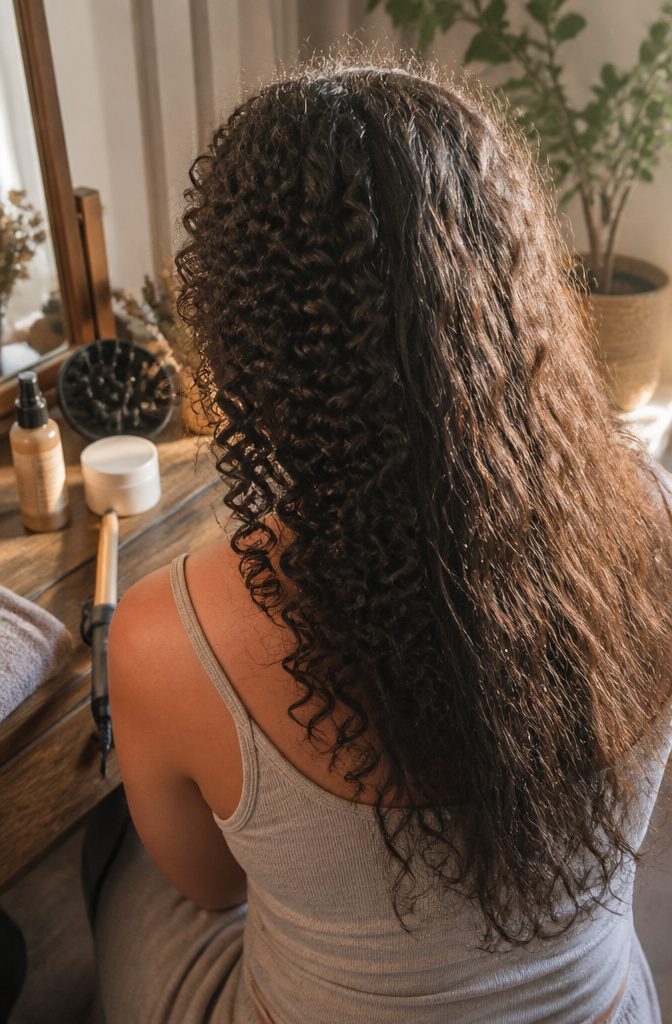
Your curl pattern is genetically determined, but it can shift over time. Ceremonia points to environmental conditions, hormones, diet, and the hair cycle itself, which renews every three to five years and can bring changes to texture and curl definition.
What you see at twenty-two might not be what you have at thirty.
Heat damage is a bigger risk. AI Free Forever notes that repeated heat exposure can loosen the curl pattern, and if the cuticle is compromised, that change may be permanent.
Chemical processing does the same. The natural architecture is set by your genes, but how you treat your hair decides whether that pattern stays intact or gets rewritten.
Frequently Asked Questions
How do I determine my curl pattern?
Wash your hair and let it air-dry completely without adding any product, then compare the natural pattern to the chart.
Look at whether your hair forms waves, curls, or coils, and match the tightness of the bend to the letter subcategory. Most people have more than one pattern on their head, so expect to see a mix.
What is the difference between 3B and 3C curls?
Type 3B forms springy ringlets about the diameter of your index finger, while 3C produces tighter corkscrew spirals about the circumference of a straw.
Both are curly rather than wavy, but 3C coils more densely and brings more volume from the roots.
Can your curl pattern change?
Your natural pattern is genetically determined, but it can shift over time due to hormones, diet, environmental conditions, and the hair cycle that renews every 3 to 5 years.
Heat damage and chemical processing can loosen the curl pattern, and if the cuticle is compromised, that change may be permanent.
What is curl shrinkage and is it normal?
Shrinkage is the difference between your hair’s wet stretched length and its dry curled length, and it signals healthy elasticity.
Type 4C hair can shrink 70 to 75 percent of its actual length when dry. The tighter the coil, the more shrinkage you’ll see.
What is the difference between 4A and 4B hair?
Type 4A has dense, springy S-pattern coils about the circumference of a crochet needle with visible circular definition. Type 4B bends in sharp Z-shaped angles rather than forming circles, and the coils are tighter with less visible curl structure.
Is 4C the most fragile curl type?
Yes.
The tight Z-shaped coils bend dozens of times per inch, and every bend is a potential break point during detangling or manipulation. Protective styles and gentle handling are non-negotiable if you want to retain length.
What are 2A, 2B, and 2C curls?
Type 2A sits closest to the scalp with loose S-bends mostly from the mid-lengths down.
Type 2B has more defined S-waves that start closer to the roots and give the hair more body. Type 2C produces strong S-bends right at the roots with enough structure that some waves tighten into loose ringlets by the ends.
Are my curls 2B or 2C?
If your S-wave starts a few inches down from the scalp and gives moderate volume, you’re likely 2B.
If the S-bend starts forming at the roots and some of those bends turn into loose ringlets by the ends, that’s 2C. Type 2C sits right at the edge between wave and curl.