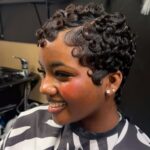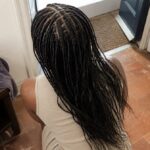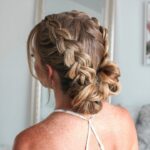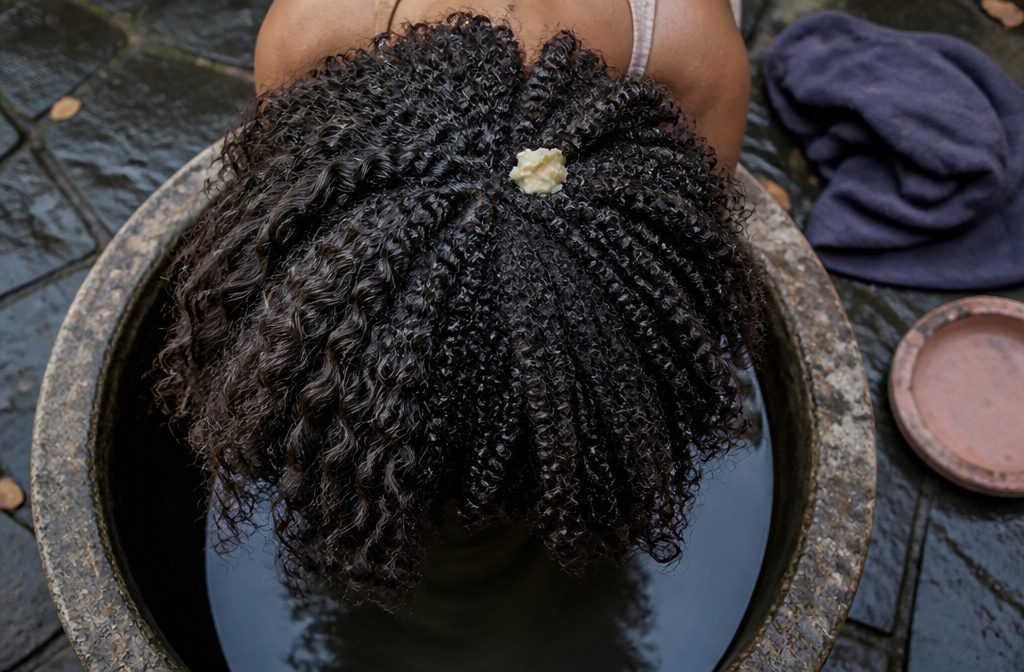
Hair curls in four numbered families, from loose waves through tight coils, and the letter after each number tells you where you sit.
The tighter the pattern, the heavier the product should be. Type 2 waves weigh down under thick cream, while 4C coils snap without shea butter and oil to seal moisture in.
1. Type 2 Wavy Hair
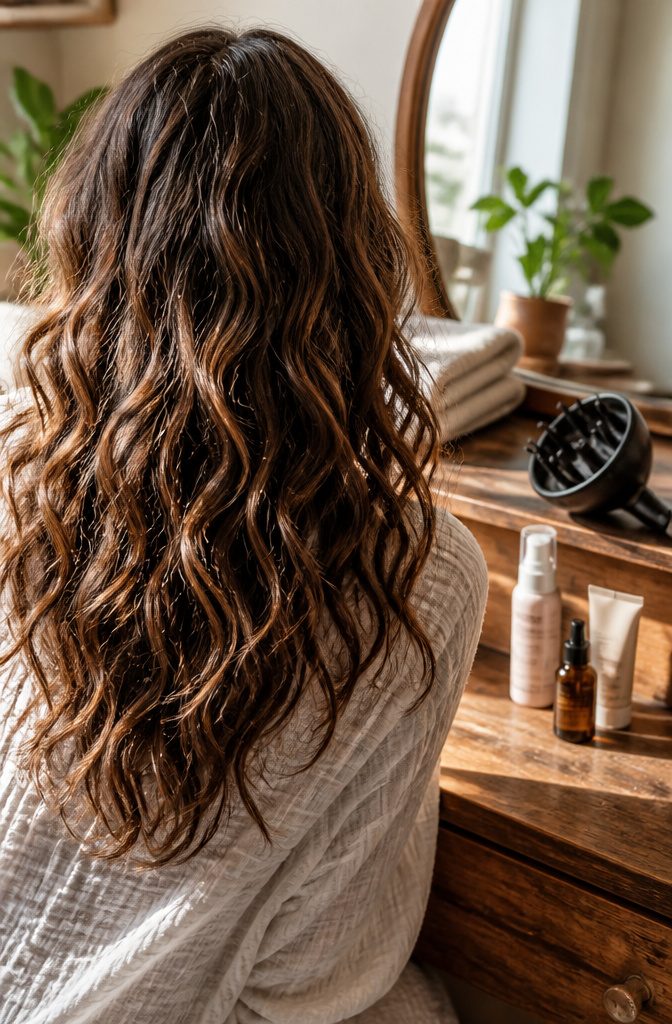
Type 2 wavy hair forms loose or defined S-shaped waves that sit between straight and curly. The subtypes move from barely-there texture toward deeper bends.
2A is fine, tousled and easy to heat-style. 2B shows straight roots and gradual curl toward the ends, what celebrity stylist Kim Kimble calls beachy waves with a loose S-pattern and little bounce.
2C starts waving right at the roots with more definition and volume, almost crossing into curl territory.
All three need lightweight products.
Wavy hair is finer and smoother than tighter patterns, so it weighs down fast. Water-based lotions and creams smooth the strand without killing movement.
Light serums, mousses and gels handle frizz without drag. Diffusing adds volume if you want it.
2B and 2C benefit from masks about twice a month for moisture and manageability. Frizz is more common here, and 2C is especially vulnerable to heat damage when chemically treated.
2. Type 3 Curly Hair
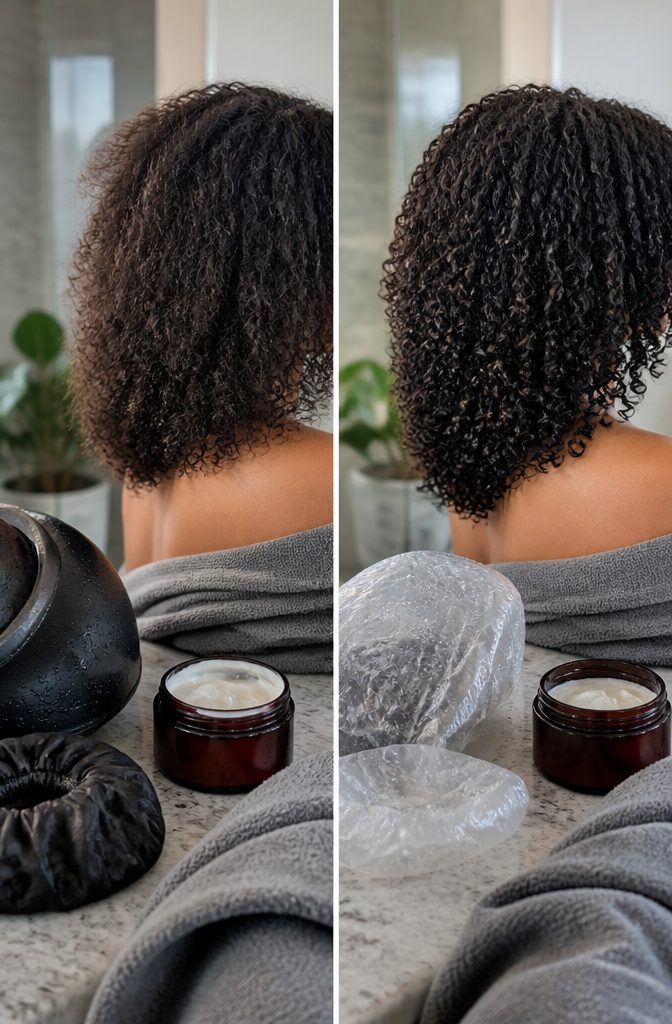
Type 3 curly hair is what you see when someone has actual spirals, ringlets or corkscrews instead of waves or loose bends.
The family divides into three subtypes, and the main shift as you move from A to C is tightness and density.
Type 3A curls are about the size of sidewalk chalk or a permanent marker, with a loose spiral and not much shrinkage. These curls have natural shine but frizz easily.
Shampooing every five to seven days keeps them healthier, since washing more often dries them out. Masks or leave-ins work better than standard conditioner.
Type 3B is a tighter curl, with a springback of one to two inches that needs more TLC.
— Glamour
Type 3B curls are about the size of a Sharpie marker and bounce back one to two inches when you cut them.
They have more body than 3A and tend to be looser at the front of the head. Weekly wash days are the target here, and you get the best results using masks with heat every time you cleanse.
A deep-conditioning cap you can microwave helps, or sit under a bonnet dryer to get the product all the way in.
Type 3C curls are about the width of a pencil, the tightest of the three.
They are fine textured, prone to frizz, and shrink a lot. These curls are also called corkscrew curls and have serious volume.
3. Type 4 Coily Hair
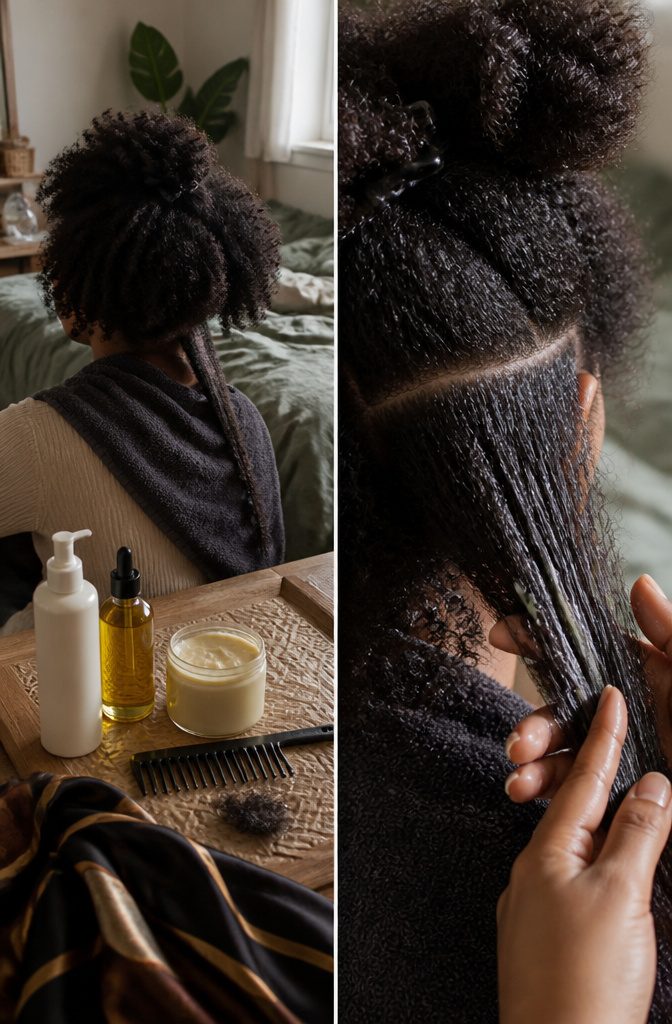
Type 4 coily hair forms the tightest curl pattern, with strands that pack densely and shrink dramatically when dry. The family divides into 4A, 4B, and 4C based on coil size, definition, and how much length the curl hides.
4A curls are about the size of a crochet needle—or you can fit a toothpick inside the curl loop.
They’re springy and well-defined, with plenty of volume. I recommend the LOC method here: layer leave-in, oil, then cream to lock moisture in before it escapes.
4B coils are tighter still, often forming a Z-shape rather than an S, and they shrink enough that the hair looks shorter than it actually is.
4C wraps so tightly around itself that you might not see the zigzag pattern until you stretch it.
4C is the most fragile of all curl types and snaps easily if you try to blow it out or straighten it without protection.
All three subtypes need heavier moisturizers—jojoba, coconut, and shea formulations deliver the hydration these fine, breakage-prone strands demand. Deep-condition weekly, and apply products in sections to avoid snapping the curl.
4. Subtype Letters A, B, and C
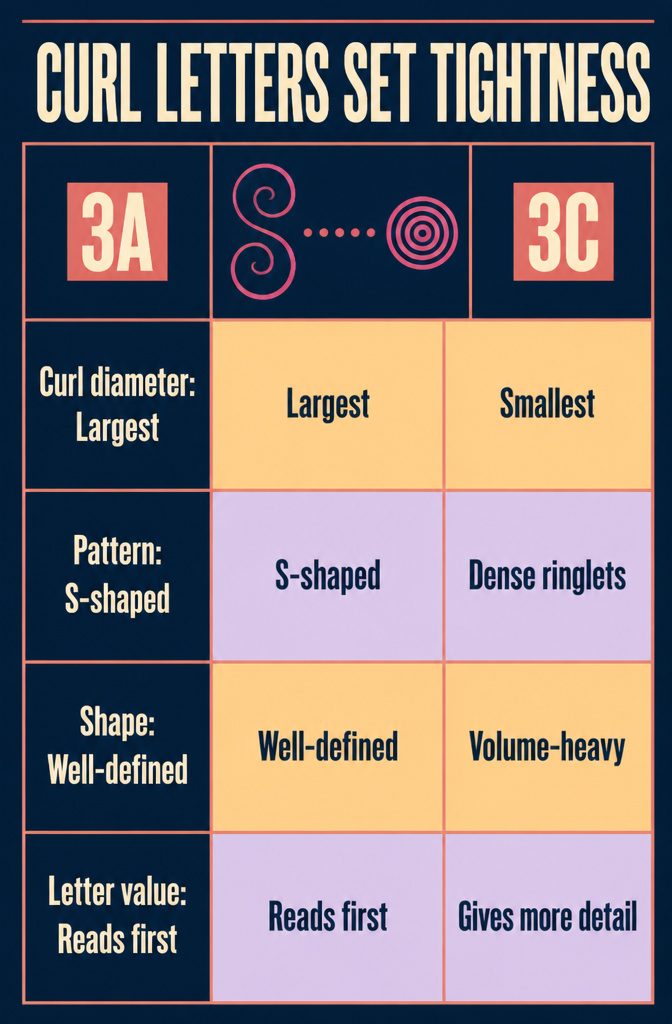
Every numbered family splits into three letters, and the letter tracks curl diameter. A is the largest curl and C is the smallest, so the letter tells you how tightly the strand is wound.
The same logic runs through wavy, curly and coily hair, which makes it the one piece of the system worth memorizing.
Type 3 shows the spread well. A 3a curl is well-defined and springy, with an s-shaped pattern, while 3c packs into dense, volume-heavy ringlets.
Both are curly, yet they look nothing alike. A saved photo tagged only "3" tells you less than the letter does, so I read the letter first.
Type 1 Straight Hair
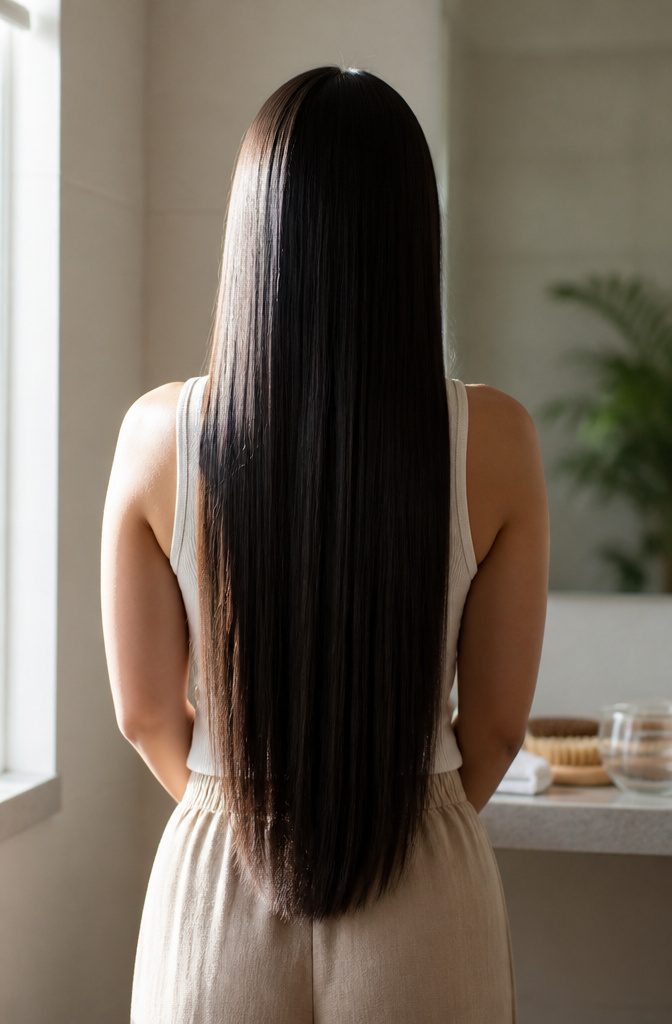
Type 1 is straight hair, no curl at all.
It sits outside the wavy, curly and coily families that begin at Type 2. Straight hair has no sub-classifications because there is no bend or pattern to measure.
The sebaceous oils from the scalp travel straight down the length of the hair shaft with nothing to slow them, which makes Type 1 the oiliest of the hair types.
It is also the shiniest, because the smooth surface reflects light directly back instead of scattering it the way a curl would. Type 1 is the most resilient hair type, very hard to damage.
The curl families we care about here start at Type 2 wavy and move through Type 3 curly to Type 4 coily, each with subtypes that get tighter as you move from A to C.
Why Care Varies by Pattern
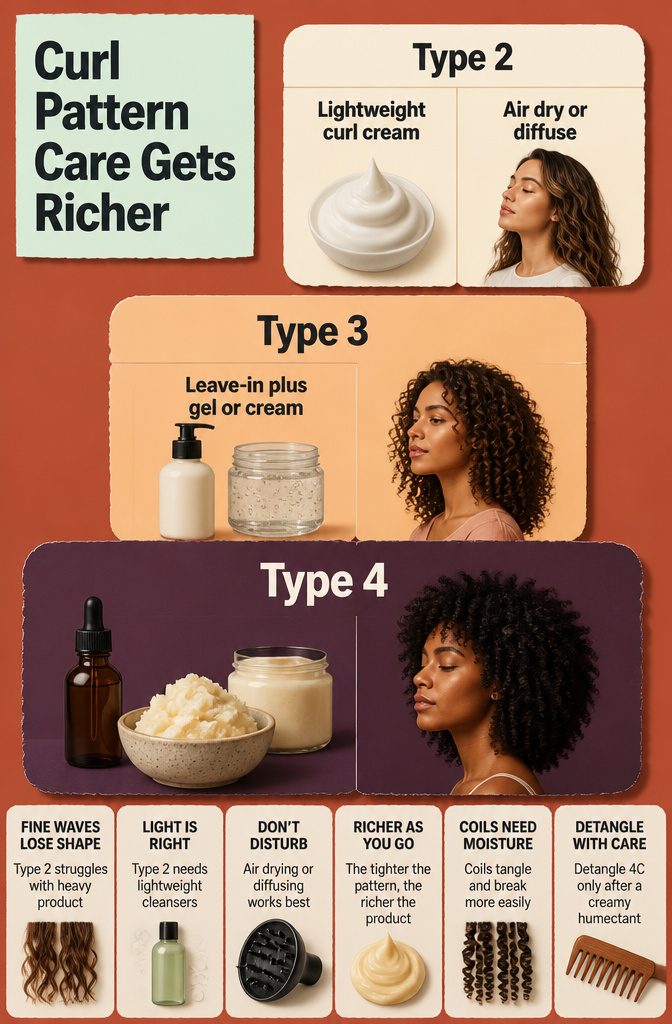
Fine waves lose their shape under heavy product, so Type 2 does best with a lightweight curl-defining cream and a light shampoo and conditioner. Air drying or diffusing keeps the S-pattern from being disturbed.
Tighter patterns flip that logic.
Coils tangle and break more easily, and frizz shows up when the strand runs dry, so the tighter the pattern, the richer the product should be. Type 3 gets by with a leave-in plus a gel or cream for definition.
Type 4 wants deep conditioning, oils and butters to seal moisture in. Thick shea butter creams suit 4A, and I’d detangle 4C only after a creamy humectant is on the hair.
Frequently Asked Questions
What different types of curly hair are there?
There are 4 main curl types: Type 1 (straight), Type 2 (wavy), Type 3 (curly), and Type 4 (coily). Each type splits into 3 subtypes labeled A, B, and C based on curl diameter, with A being the largest curl and C the smallest.
That gives you 12 distinct patterns once you factor in straight hair, though most people have a mix of at least 2 types on their head.
How do I figure out my curl type?
Compare your hair’s pattern to the descriptions of each type and subtype. Type 2 forms S-shaped waves, Type 3 forms spirals or ringlets, and Type 4 forms tight coils that shrink dramatically when dry.
Within each family, measure the diameter of one curl: 3A is about the width of sidewalk chalk, 3B is Sharpie-marker width, and 3C is pencil-thin.
Why does knowing your curl type matter?
It guides product and routine choices so you don’t weigh down fine waves with heavy cream or leave tight coils dry with lightweight formulas.
Type 2 needs water-based lotions that won’t kill movement, while Type 4 needs oils and butters to seal moisture into fragile, breakage-prone strands. The tighter the pattern, the richer the product should be.
How should I determine the best products for my curl type?
Start with your curl type, then factor in porosity, elasticity, and curl variance. If your hair floats in water it’s nonporous and needs heavier creams, while hair that sinks absorbs easily and does better with lighter, water-based products.
Your crown likely has several curl patterns, so test in sections rather than treating all of it the same way.
How can I enhance my natural curls?
Match your product weight to your curl type: Type 2 waves need lightweight curl-defining cream and a diffuser to avoid disrupting the S-pattern, while Type 3 curls want leave-in conditioner plus gel or cream for definition.
Type 4 coils get the best results from deep conditioning weekly, then layering leave-in, oil, and cream to lock moisture in before it escapes. Apply products in sections to avoid breaking the curl.